

 What causes the “blue” in blue cheese?
 To create a blue cheese, it’s necessary for blue mold spores to be present in the cheesemaking environment and/or for them to be introduced into the milk during the early stages of production.
In commercial cheesemaking these spores are in the mixture of bacteriological starter cultures that help give the cheese its identity as it matures. There are two molds used in the making of blue cheese: The best-known and the more piquant version is Penicillium roqueforti, which originated in the caves at Roquefort in France, thereby giving the famous cheese its name. This mold is also used in cheeses such as Ireland’s Cashel Blue and British Stilton. A milder version of blue mold called Penicillium glaucum is found in Bleu d’Auvergne and Gorgonzola Dolce.Amazingly, it takes only one teaspoon of blue mold to inoculate a 1,500-gallon vat of milk.
At a certain point during aging, the cheese is usually pierced with needles to add in the “bluing.” This allows air to enter the cheese, where it reacts with the enzymes and spores, activating the blue mold in the pierced areas and along any naturally occurring fissures in the paste. The mold continues to develop as the cheese matures, helping to break down the paste until it reaches the desired consistency and potency. The extent to which the blue mold and “veining” are present in the cheese is controlled by the cheesemaker and, in the case of name-protected cheeses, governed by its traditional recipe.
Sometimes customers tell me they do not like blue cheese, and I am quick to explain that there are many different flavor characteristics within the blue family. If you do not like sharp blue cheeses such as Stilton, try a milder one, such as Cambozola Black. I also recommend pairing blues with fig paste or artisanal honey; the sweetness curbs the sharpness of the blue and adds more flavor dimension to the cheese.
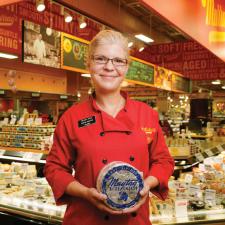
Melissa Wood
As cheese master at one of Kroger’s markets in Cincinnati, Ohio, Melissa helped develop the working model for the Kroger/Murray’s cheese shop in each supermarket as well as its training program for cheese stewards