
Made in Japan
Far from the tsunami-ravaged northeastern coast, artisan cheesemaking thrives in Nagano
One peaceful day last March I lay down to take an afternoon nap. I had arranged to visit Shimizu Farm, one of Japan’s top farmstead cheese companies, the following day and had spent the morning researching some of the other local producers I planned to profile for this article. I awoke to find my house shaking. Japan had just suffered the strongest earthquake in its recorded history. Over the next few hours, four-story-tall tsunamis would flatten entire towns and kill more than 10,000 people along the country’s northeastern coast. Suddenly, writing about cheese felt absurd.
But Nagano Prefecture—where both the Shimizus and I live—was practically unscathed, and there was little I could do yet to help those up north. So the following day my husband and I piled into our car as planned and headed for the mountains. We live in the old castle town of Matsumoto, which lies in a wide, fertile valley sheltered by the Japan Alps, about three hours by car from Tokyo. The Shimizus live and farm an hour and a half’s drive to the west, so high in those snowy mountains that nothing but grass and wildflowers will grow. Up and up we drove, past the last alpine village, until, finally, we reached a cluster of simple wooden buildings. And there stood Norihei and Harumi Shimizu, welcoming us to a place that seemed a world away from the disaster unfolding to the north.
Mountain Made
For the Shimizus, top-quality cheese is all about the grass.
“Nothing good comes from black-and-white Holsteins that stay inside and eat rations,” Norihei said. “We wanted to make something like French alpage cheeses from high in the mountains, where the milk tastes different because the pasture is different.”
In fact, the couple pined for alpage so deeply that after two decades of cheesemaking in the lowlands, they moved their herd of 30 Brown Swiss cows and 60 Friesland sheep to a mile-long, unfenced pasture at an elevation of nearly 6,000 feet (putting cows on pasture is rare in Japan, where land is at a premium, and grazing them in the mountains even more so).
“I always feel like Heidi is about to come wandering out of the woods,” said Harumi—who, with rosy, round cheeks, sparkling eyes, and a seemingly boundless enthusiasm for her chosen craft, seems like a grown-up version of that storybook character.
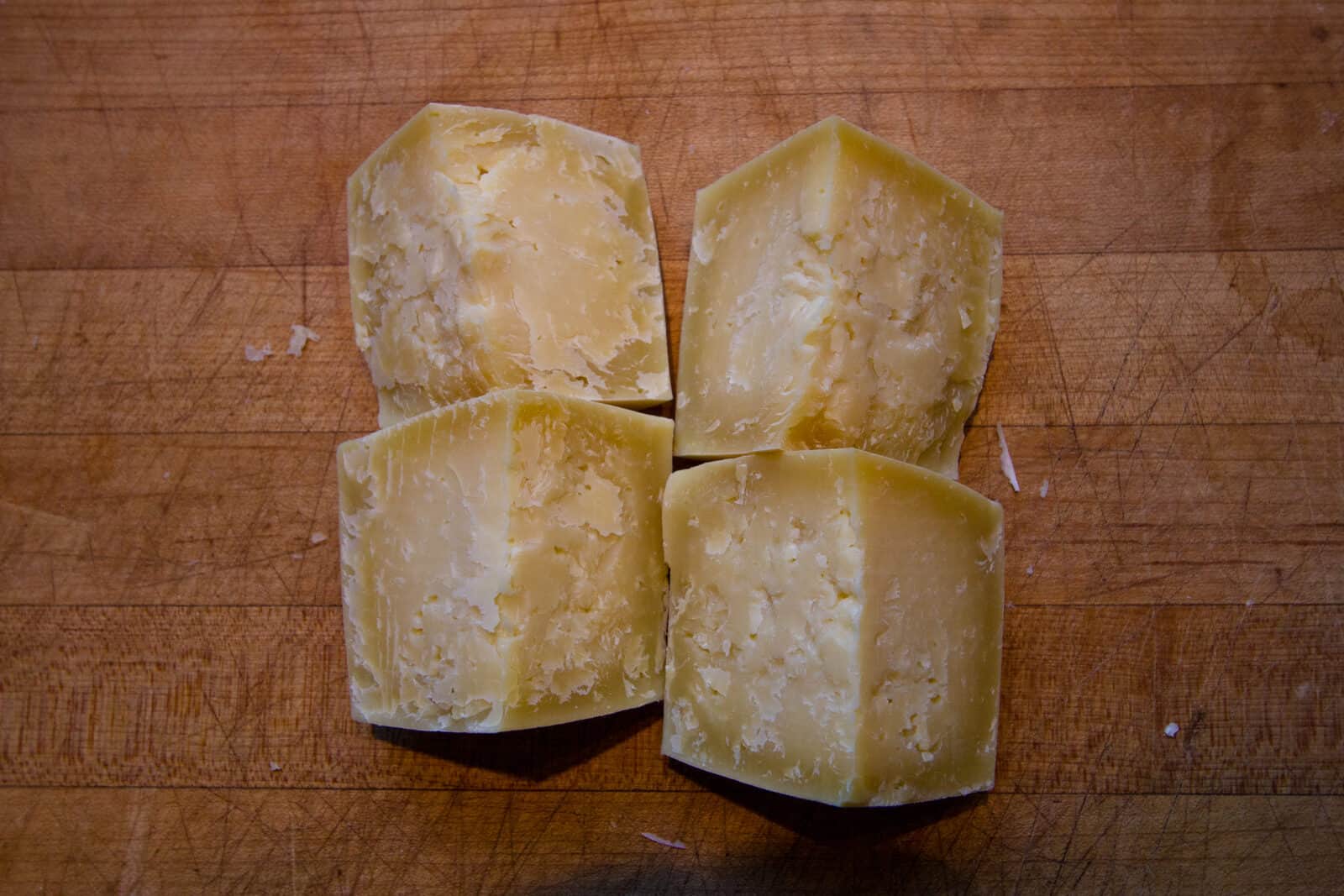
On the day we visited, the couple took time out from a dawn-to-dusk milking and cheesemaking schedule for a tasting session in their rustic shop. The cheese plate included thick wedges of semihard, washed-rind mountain cheese and slices of firmer Bergkäse, whose nutty, complex flavor is developed over a nine-month aging period. Then there were pots of tangy quark with homemade marmalade, and an airy, milk-fragrant fresh cheese called Petit Nuage (“Little Cloud,” in French). Several part-time workers help out in the shop and barns, but Norihei makes all of the cheese alone, by hand (quite literally—citing his hands and eyes as his most reliable tools, he will dip a finger rather than a thermometer into a vat of milk to monitor its progress).
The resulting selection of farmstead cheeses is so delicious it literally made me laugh with the sudden recollection of just how good simple, carefully made food can be. It was only later, as we descended the mountain and the scratchy radio news came into focus, that I was thrust back into Japan’s other reality, of earthquake-damaged nuclear reactors, hungry refugees, and farmers pushed off their land by radioactive contamination (which, thankfully, has not reached Nagano). It would be two weeks of covering those disasters before I thought about cheese again.
Where to Look
Finding good artisanal cheese in Japan is a bit like searching for the hidden door in a seemingly dull library. Scan the shelves of the local grocery, and you will be disappointed. But travel to remote mountain farms and snowbound northern dairies, comb the stalls of underground food bazaars or track down out-of-the-way specialty shops, and you’ll be rewarded with a growing selection of carefully crafted, innovative delicacies.
“People are so keen to make cheese here, and they always follow the highest standards. Japan is very strong in terms of technology,” said Rumiko Honma, founder of a Tokyo cheese shop that supplies the city’s best French restaurants. Also an author on the subject, she added that several domestic brands—while pricey and saddled with government regulations that require pasteurization—match up to anything she imports from abroad (Shimizu Farm is one of four Japanese brands she stocks).
Cheese has a relatively short history in Japan. The first domestic manufacturer, Snow Brand, opened its doors in 1925, and high-quality imports didn’t start to arrive in bulk until a planeload of French Camembert was flown in for the 1964 Olympics. Today the average resident eats her way through about four and a half pounds of cheese per year (a sliver compared to consumption in the U.S. or France, but a five-fold increase from the 1970s), and at least 150 domestic companies produce natural, handmade varieties.
“At first everyone copied European techniques and flavors, but Japan is now in the process of developing its own style,” said Seiji Fujino of the Cheese Professional Association in Tokyo. Makers are wrapping wheels in bamboo, cherry, or shiso leaves, washing them with sake, and paying more attention to visual presentation, he said. Chefs, meanwhile, are serving up Roquefort sushi, miso soup with Comté, and fresh mozzarella with wasabi-soy dipping sauce.
About 90 percent of Japan’s cheese comes from Hokkaido, the archipelago’s northernmost island and its biggest milk producer. But you don’t have to go that far for a taste: some of Japan’s best varieties are made right in Nagano Prefecture, a beautiful and easily accessible part of the country.
Bigger Gets Better
Back in 1982, the same year Harumi and Norihei Shimizu were establishing their dairy farm, Nagano’s other royal family of cheese was establishing its own company, Atelier de Fromage, in the mountains to the east of Matsumoto. At first Yoko Matsuoka and her husband, Shigeo, ran a dairy farm as well as a cheese factory, but they soon switched to buying milk from local farms. Today Yoko manages a sprawling cheese empire with 50 employees making 13 kinds of cheese, yearly sales of over $5 million, and six shops that sell cheese, as well as regional wines and freshly baked pastries.
Every day, a team of four cheesemakers at the main shop processes about a thousand pounds of milk in a state-of-the-art plant where thermometers and timers most definitely take precedence over fingers. In an adjoining sun-filled café, guests can order camembert-apple pie, mascarpone cream puffs, or pizza with house-made mozzarella. On the afternoon I met Yoko Matsuoka there, the energetic 50-something businesswoman was getting ready to roll out a new dolce blue cheese; the company also sells an excellent picante version, a “camembleu” (bleu cheese sandwiched inside Camembert), and a goat’s milk blue.
“Why so many types?” I asked.
“My husband is the kind of guy who likes to experiment,” Matsuoka replied. “And from the start, I didn’t just want to make cheese. I wanted to be able to make a whole cheese plate with our own cheese. I wanted to make a cheese world.”
The surprising thing is, she’s managed to do so without sacrificing quality: the rich, soft dolce blue made with a mixture of milk from Jersey and Holstein cows was so good I had seconds, then thirds, before reminding myself I had another farm to visit and another cheese plate to sample.
Dairy Destination
For many Japanese cheese companies, making a good artisanal product is as much about drawing tourists to depressed rural areas as it is about perfecting flavor. Cheeseries often feature cafés, workshops, or observation areas so that visitors can turn shopping trips into longer family outings. I visited two such companies in Nagano.
Located in a remote village in the southern part of the prefecture, the Highland Ice-Cream Factory was founded just over a decade ago to turn local milk and produce into high-quality frozen dessert. “We wanted to bring life to the town by making use of what’s grown here,” explained creamery manager Nobuhiro Saito.
The ice cream—available in 14 flavors including sesame, buckwheat, mugwort, and sweet corn—proved popular, so two years later Saito took charge of developing a line of cheeses. Today seven employees turn out a reliable selection of Japanese favorites—Camembert, mozzarella, string cheese, and Gouda—sold mainly to tourists through a small shop on the property. But the real reason to visit the shop is the cream cheese, a soft, silky concoction closer to salty crème fraîche than to anything packaged in silver foil and sold at supermarkets. Another attraction is the gorgeous alpine setting (as Saito said apologetically, “There’s nothing around here but nature”).
A knock-your-socks-off location is also the main draw of Nagato Farm, perched high in the mountains southeast of Matsumoto. Sparkling snowy fields and craggy peaks stretch in all directions from the 500-acre dairy farm; an on-site restaurant with a wood-fired pizza oven and three walls of picture windows offers incredible views.
Company president Hisao Kobayashi told me that about 200,000 tourists visit the farm each year to take classes on making cheese, butter, ice cream, and admire the 270 Holstein cows, and buy natural cheeses at the gift shop. The cheesery—which uses about 20 percent of the farm’s milk—specializes in the mild, approachable cheeses most popular in Japan; the Gouda and natural cream cheese are the best of the lot.
Ski Hill Herd
Rob Alexander of Kaze no Tani Farm is one of the newest arrivals on the Nagano cheese scene, but the eco-minded Australian goat farmer and his handmade chèvre are already local celebrities. Part of the appeal, no doubt, lies in Alexander’s novel choice of location: the former snowboard photographer grazes his herd of 16 milkers on the ski slopes of Hakuba, a resort village an hour and a half’s drive north of Matsumoto.
“Ski hills in summer were always on my mind, because they’re massive unused spaces,” explained the longtime resident of Japan as we chatted in his barn. About a decade ago, on a trip to France, a friend converted him to the pleasures of good goat cheese. Right then “it all came together: goats, ski hill, cheese,” he said.
Alexander’s formula sounds whimsical, but it works. “The girls,” as he calls his herd, browse on a healthy range of forest brush, leaves, and grass; their milk ends up as a snow-white cheese with a clean, mild flavor. Animal-loving Alexander, meanwhile, spends his days doting on an extremely friendly group of Alpine and Saanen goats. “Whenever I get a chance, I grab them and give them a hug or a kiss,” he said as he stood in a sea of nuzzling nannies, brush in hand. He also spends a lot of time observing the animals, and every day from spring through fall he takes them on long walks across the terrain.
During grazing season, Alexander and an assistant make about 60,000 palm-sized rounds and pyramids of fresh cheese, rolling some in herbs or ash, aging some slightly, and preserving others in herb-infused rice oil for winter sales; most are sold to shops and restaurants nearby. As for flavor, he’s careful not to push the limits of what Japanese consumers will accept.
“I have to make a light, inoffensive cheese. In three or four years, when we’ve conquered the world, I can start making something more intense,” he joked.
In that regard, Alexander is representative of many of Japan’s artisan cheesemakers, who, having mastered the basics, are on the verge of crossing from familiar flavors to riskier, more interesting ones. They’ve also got the passion needed to make world-class cheese. In the face of Japan’s ongoing recovery, those qualities are more valuable than ever.

There are 70,000 farmers in the Fukishima region of Japan who have been devastated by the effects of the tsunami and nuclear reactor meltdown. To support their recovery, you can donate to the American Friends of the Asian Rural Institute (AFARI), a community-development nonprofit working in sustainable, organic agriculture techniques and leadership (friends-ari.org).
Cheesemaker Information
Atelier de Fromage
Main location: 504–6 Mihari,
Tomishi
+81-268-64-2767;
fromage@mercury.plala.or.jp
Open daily 10–5:30 (6 on Saturday);
café open 10–4:30 (5 on Saturday)
Highland Ice-Cream Factory
4411–9 Suekawa, Kaida Kogen
+81-264-3306; info@hif.jp
Open daily 10–5, April–November;
Wed–Mon 10–5, December–March
Kaze no Tani Farm
Hokujo, Hakuba-mura
+81-261-72-4775;
info@kazenotanifarm.com
Nagato Farm (Nagato Bokujo)
3539–2 Daimon, Nagawa-cho
+81-267-55-6969
Open Wed–Mon 10–4:30,
April–November; Thu–Mon 11-4,
December–March
Shimuzu Farm (Shimizu Bokujo Cheezu Kobo)
51 Narakawa, Matsumoto
+81-263-79-2800; svarasa@avis.ne.jp
Open Wed–Mon 10–5
Written by Winifred Bird
Photography by Gianni Giosue