
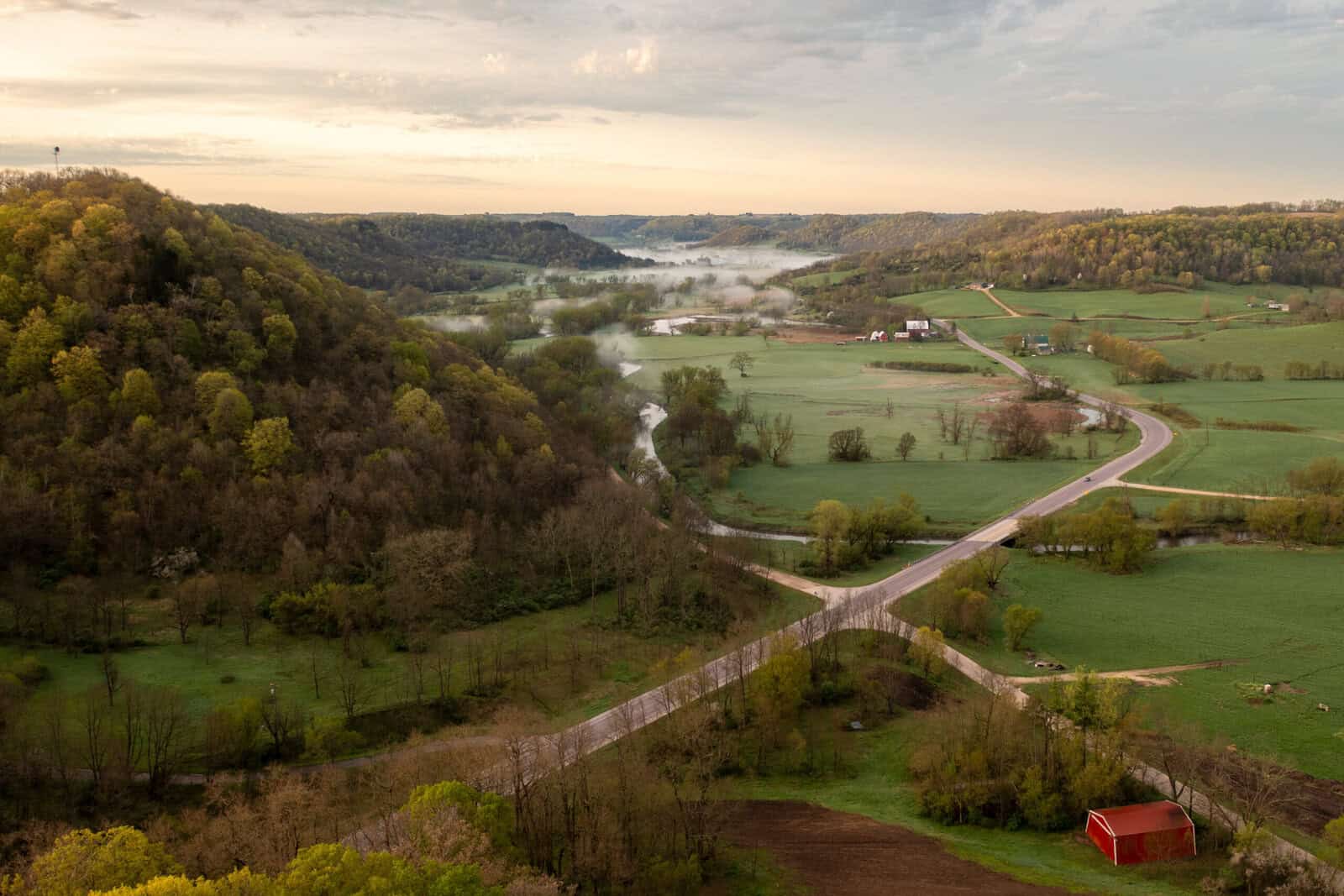
In Wisconsin’s Driftless area, a landscape untouched by glaciers has shaped not only the flavor of its cheeses, but the lives, traditions, and global influence of the people who make them.
Almost two decades ago, in between viewing apartments in Madison, Wisconsin, I ordered a peach Melba ice cream from Babcock Dairy Store at the University of Wisconsin–Madison Memorial Union. Out on the terrace, an artist was capturing an idyllic summer scene on the lake, and I thought, how did I not know about this place sooner? At the time, I didn’t realize the Babcock name was woven into nearly every thread of Wisconsin’s dairy history. Not long after, I became a regular at the Dane County Farmers’ Market. That’s where I first tasted Brunkow Cheese’s Brun-uusto—caramelized cubes of cheese hot off a griddle were handed to a crowd that never waned.
Years later, I found myself living around the corner from Joe Burns, the maker behind that very cheese. I’d walk to his house each week to teach piano lessons to his children, while he worked on a new Trappist-style cheese called Pavé Henri, named after his son who begged him to stop making it because he didn’t like the way his dad smelled when he came home from the creamery.
In Wisconsin’s Driftless Area, cheese is not just a product—it is a presence.
The Land That Refused to Flatten
During the last Ice Age, the glaciers missed this rough, oval-shaped part of the upper Midwest that spans parts of Southeast Minnesota, Northeast Iowa, Northwest Illinois, and Southwest Wisconsin. This lack of glacial drift—the sediments deposited by glaciers—is why the region is called “Driftless.” It’s the only unglaciated spot in the world, completely surrounded by flat land bulldozed by ice: A 24,000-square-mile island standing prominently with rolling hills, deep valleys, winding rivers, streams, and numerous rock outcroppings, with striations displaying the history of various ancient geological events.
Trapped between valleys is fine, windblown soil (loess), and stones eroded by rivers reveal Paleozoic Era sedimentary rock composed of Ordovician dolomite, highly porous limestone, sandstone, and shale. The land is covered with forests, prairies, oak savannas, wetlands, and grasslands, with a multitude of animal and prehistoric plant species uniquely suited to its microclimates.
“All of the cheesemakers in the Driftless region know that the limestone in the area that’s filtering the water for our animals and our crops has a huge impact on the flavor of our cheese,” says Tony Hook of Hook’s Cheese Company in Mineral Point. A cheesemaker for more than five decades, Hook founded his business with his wife, Julie, in 1976 and transformed it from commodity production into one of Wisconsin’s most distinguished artisan creameries. His long-aged cheddars and small-batch cheeses are timeless, sourced from the same dairy farms for over 46 years.
The beauty of this place can be misleading. The Driftless is not a soft landscape. Living here urges a person to stand still and observe with all senses: to listen, accept what is, and be one with its slow pace. Each day, with courage, folks stick their hands out the door—like human thermometers—to gauge the weather and decide how to dress. Even then, emergency supplies are kept in cars, and people have at least one trusted friend in every town.
Why Cheesemakers Came—and Stayed
Cultural migration was a significant catalyst for the transition of Wisconsin from a wheat economy to dairy. In the late 1800s, a large population of Swiss immigrants moved to Southern Wisconsin, nicknaming the areas of Dane, Rock, Iowa, and Lafayette counties “Swissconsin.” The hilly landscape and rich pastures resembled Switzerland and was ideal for erecting small farms, raising cattle, and making cheese. Looking to preserve their traditions and culture, these immigrants practiced what they knew: recreating the food they’d grown up eating.
Cheesemaking was initially confined to the kitchen and considered women’s work—a way to preserve food and feed families during harsh winters. But that soon changed. One of the first cheese factories in the Driftless opened in 1868: a limburger operation by Nickolaus Gerber in New Glarus. Germans, Scandinavians, and Italians began to settle in the region as well, bringing their cheesemaking traditions with them, too.
Scientific advances followed. The increase in dairy production plus improved herds led to higher standards of milk quality. The architecture of dairy farms also improved, leading to more efficient practices and distribution.
In 1890 at the University of Wisconsin, Stephen Moulton Babcock discovered a way to test butterfat content in milk. By the turn of the century, students could enroll in cheesemaking courses at the University of Wisconsin–Madison, and by 1986, the Master Cheesemaker Program—the only one in the US—was established.
Cheesemaking in the Driftless Today
More than 3.5 billion pounds of cheese across 600-plus varieties are produced in America’s Dairyland annually. With 90 percent of Wisconsin’s milk being made into cheese and 90 percent of the state’s cheese exported across the country and globe, it has a $52 billion economic impact.
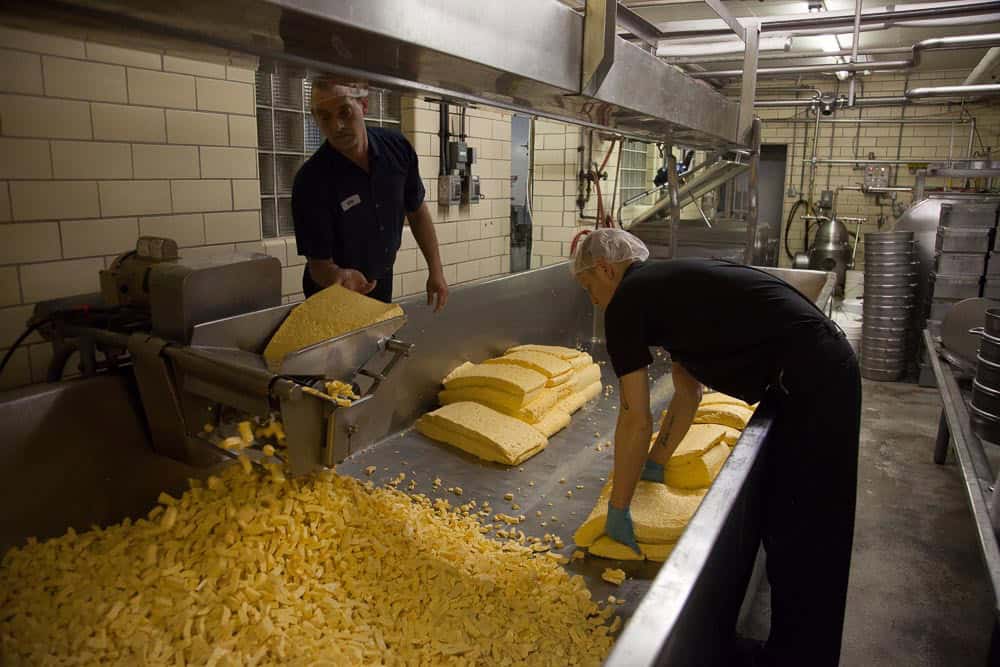
Within that vast ecosystem, few figures loom larger than Sid Cook of Carr Valley Cheese in La Valle, whose six-decade career has helped shape the state’s modern artisan identity. A pioneer of American artisanal cheesemaking and a longtime steward of Driftless traditions, Cook has built Carr Valley into a renowned creamery. “Producing cheese in the Driftless gives it a distinctive flavor,” he says, “with more fruity or floral notes that intensify as the cheese ages.” That sense of place is echoed by Catherine Young of Capri Cheese in Blue River: “The limestone is made of ancient beaches—specifically shells. There is calcium there. And in between the grains of sand, there’s calcium. There’s something about the calcium that flavors the milk and used to flavor the cultures produced here—sweet soil.”
Drive 40 miles south of Carr Valley, and you’ll find Andy Hatch at Uplands Cheese in Dodgeville—a farmstead operation utilizing old-world practices. A deep well sits on the property, just a few miles away from the Wisconsin River. The water table here is made of pure limestone—ideal for maintaining healthy animals. Each of the 150 cows in Hatch’s herd drinks about 40 gallons of water per day, and the calcium content is off the charts. It’s difficult to pinpoint exactly how this affects the flavor of the cheese, Hatch says, because the animals are eating the various perennial plants in pastures, including orchard and brome grass, fescues, timothy, clovers, alfalfa, chicory, plantain, dandelions, lambsquarters, burdock, milkweed, thistles, and more.
These plants have varied root systems, each absorbing different minerals from different depths. Some roots grow just a few inches below the soil while others, such as alfalfa and chicory, are deeply rooted, reaching down as much as 7 feet. Rotational grazing allows the herd to eat diverse grasses, spread rich organic matter onto the soil, and allow plants to regrow. The thistles are not as desirable, but they are exceptional at attracting an array of pollinators, like the rusty patched bumble bee, an endangered species.
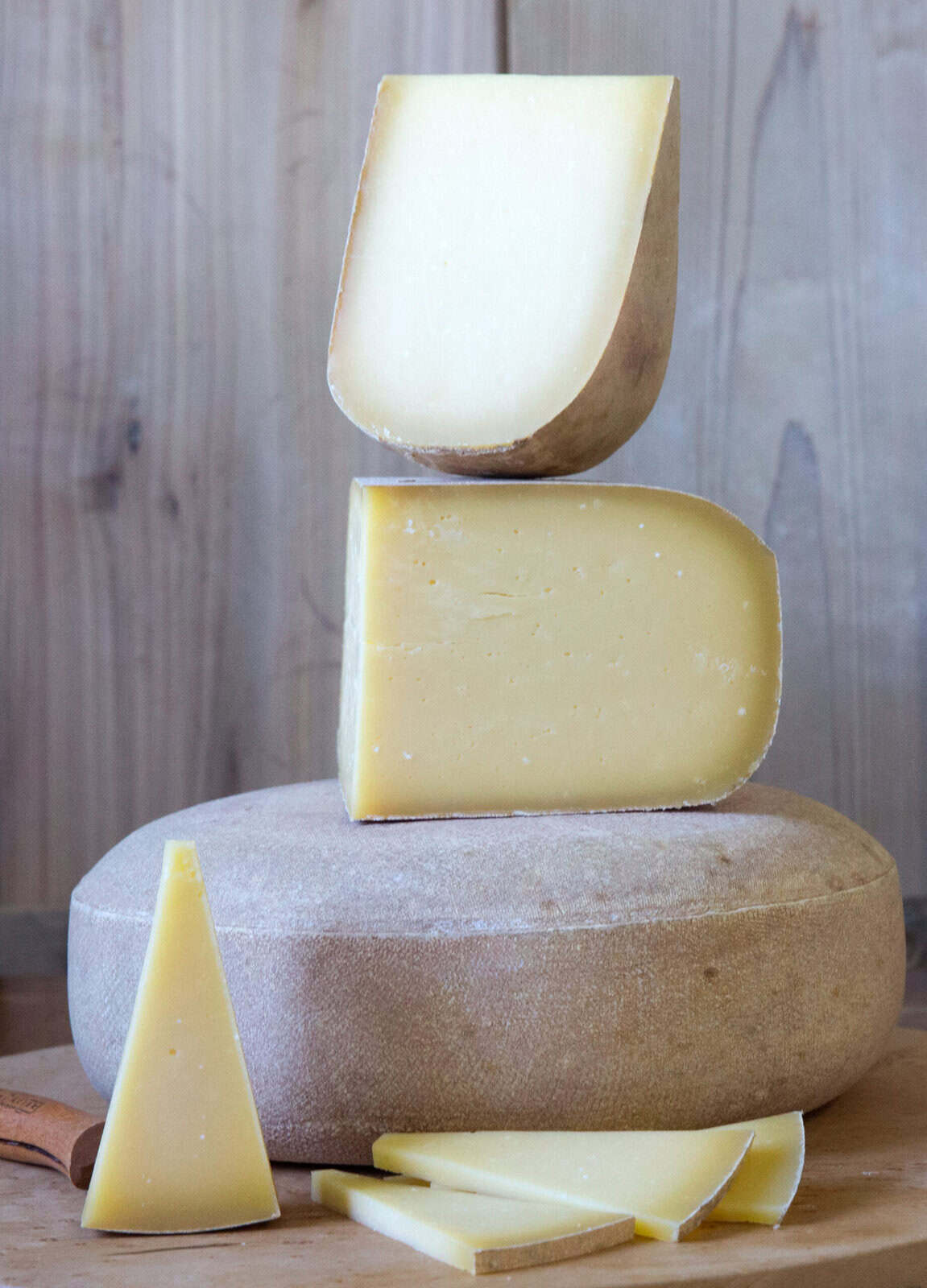
Hatch only makes two cheeses: Pleasant Ridge Reserve, an aged Alpine-style cheese made when the cows are eating fresh grass, and Rush Creek Reserve, a custardy, raw-milk cheese, wrapped in spruce bark and made when the cows are eating hay. Depending on when a wheel is made, the flavor will reflect the season and terroir of the region.
The Uplands Effect
Mary Florer-Tolan, a cheesemonger from Oklahoma by way of California, moved to the area less than a year ago. After working with Hatch at Uplands, she purchased Over the Moon Cheese, a business that delivers artisanal cheese to chefs. “As corny as it is,” Florer-Tolan says, “I feel like I finally found my calling. I like being behind the scenes, helping cheesemakers by promoting their products, helping chefs choose the right cheeses for their menus, and suggesting fun new cheeses to retailers. Beyond the satisfaction of doing a solid day’s work, knowing that the end result of my labor is someone’s joy because they’re eating a bite of cheese that my friends made—that really does it for me.”
That sense of purpose and connection doesn’t remain contained within the Driftless; it carries outward, often further than expected.
In November 2025, Hanna Lee, a cheesemaker who was working at Uplands at the time, competed in the Young Cheesemonger of the Year contest at the World Cheese Awards in Switzerland. Molly Browne, who accompanied Lee as a representative for Dairy Farmers of Wisconsin’s Cheese State University, remembers the excitement when Lee was announced as the winner. “She was acknowledged onstage at several events,” Browne says, “Prompting [the announcers] to say ‘Wisconsin’ in front of the whole world, many times over. It was thrilling, Underpinning all of it was the connection to the Driftless via Uplands. As we continued to experience the World Cheese Awards, we crossed paths with Pius Hitz, the cheesemaker who won the contest, and Hanna gifted him a piece of Pleasant Ridge Reserve.
Later, we met Ray Siebrits, a South African cheesemaker who had spent a season working at Uplands. That was a truly full circle moment that allowed me to see the international connections that had been fostered through the region.”
To live in the Driftless is to be influenced and inspired by the land and the people who live with purpose and passion: the cheesemakers, the grass farmers, the stonemasons, the vegetable and meat farmers, the grain farmers, the beer and winemakers, the artists, artisans, musicians, and chefs. Each is actively caring for the land, capturing and preserving the moments in their work. To see pride, joy, and resilience in everyday living, endure the seasons and share and celebrate with each other—it’s a life worthy of every breath. I wish you could see the potlucks.

Leslie Damaso
Leslie Damaso is a Filipino-American singer, visual artist, poet, writer, teacher and business owner at Buttonhill Music Studio in the historic community in Mineral Point.