
This interview is part of culture’s 2026 Hot List. Click here to learn more about our selection process and to see the latest Hot List class.
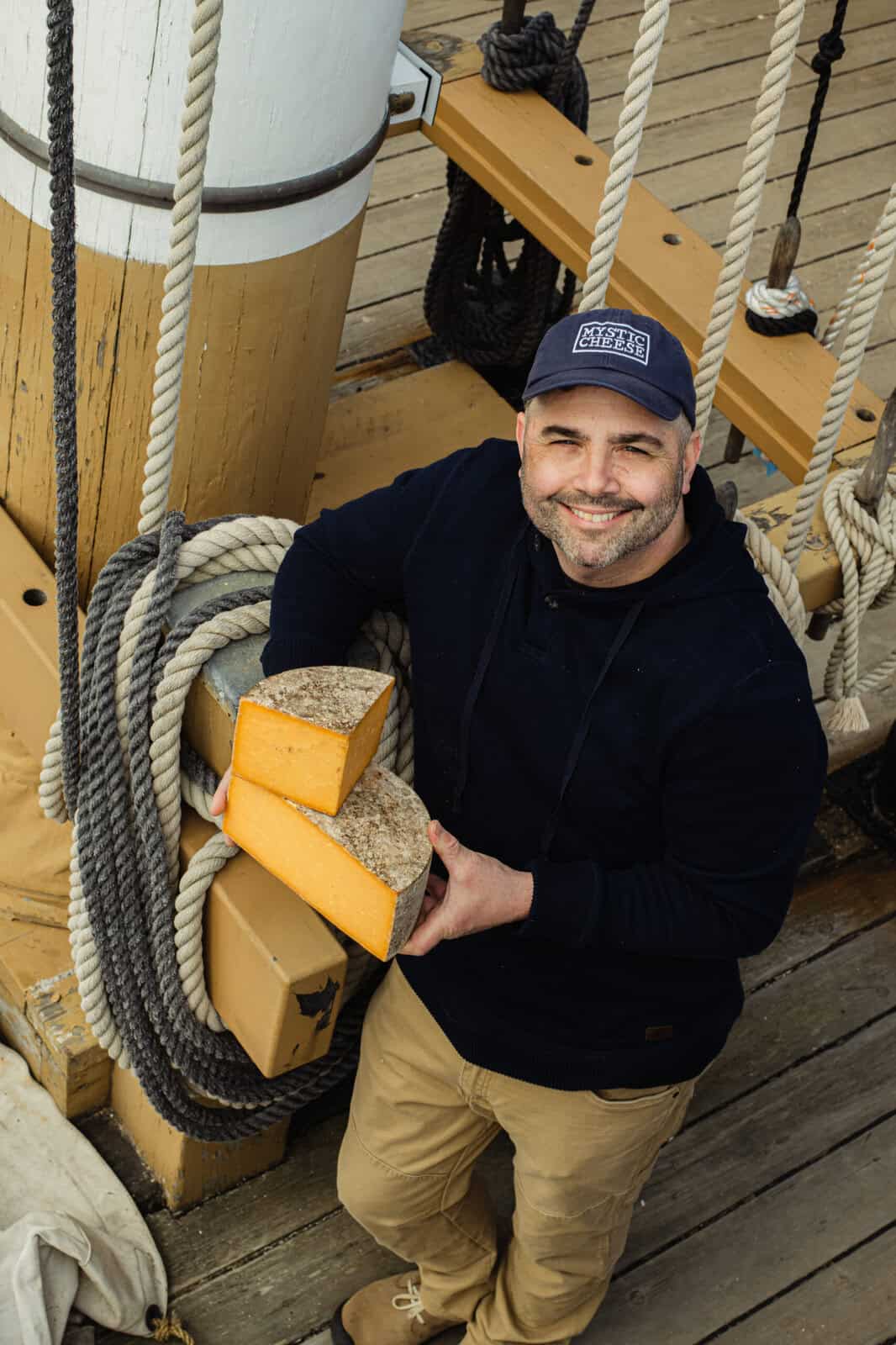
Brian Civitello
Lysis Persuader & Founder, Mystic Cheese Company
Connecticut
Brian Civitello is chasing something most cheesemakers spend a lifetime trying to define: the moment when everything in a cheese just works. From early days on his family’s Connecticut farm to apprenticing across Italy, his career has been driven by a fascination with the intersection of microbiology, manual labor, and sensory transformation. That curiosity eventually led him to launch Mystic Cheese Company in 2013, beginning in a 320-square-foot shipping container creamery and growing into a nationally recognized operation on the Connecticut shoreline.
Originally rooted in Italian styles, Civitello has spent the past several years pushing into more technically demanding territory, exploring milled-curd cheeses and reviving British Territorial styles with a distinctly American perspective. His work is defined by experimentation, persistence, and a willingness to fail in pursuit of something better—an approach that treats cheesemaking not as replication, but as discovery.
How did you first get into cheesemaking?
I grew up on a small family farm where food, wine, and cheese were always part of life. In my early 20s, I left the city and started exploring fermentation—wine, bread, cheese.
Then I went to Italy. Walking into a Parmigiano Reggiano production facility for the first time, I was hooked. The smells, the rhythm, the work—it all clicked. It felt like the perfect intersection of science, craft, and physical labor.
What fascinates you about historical cheeses?
There’s this moment in time where everything aligns—milk, environment, technique—and something incredible is created. That didn’t happen overnight. It’s the result of generations of trial, error, and necessity.
When [historical] cheeses disappear, we lose more than a product—we lose knowledge. My work is about trying to find my way back to that point, using whatever fragments remain, and rebuilding it through my own process.
How did you go from Italian styles to British cheeses?
It started with curiosity. I came across an Italian cheese that used milled curd—a technique I had only associated with cheddar. That sent me down a rabbit hole.
From there, I began exploring milled-curd cheeses across Europe, eventually landing in the British Isles. It’s been years of trial and error, learning largely on my own, and pushing myself into unfamiliar territory.
The results have been worth it. These cheeses have really connected with people.
What’s the biggest challenge facing cheesemakers right now?
It’s complicated. On one hand, we need fair pricing structures to support American producers. On the other, the industry depends on European imports to sustain independent shops.
There’s a balance that hasn’t quite been figured out yet.
Who is your cheese hero?
Honestly, anyone making and selling cheese in America right now. It’s not an easy path, and anyone choosing it deserves respect.
Do you have a favorite cheese in your lineup?
The Gray. It’s based on Cheshire—one of the original sharp cheeses in New England before cheddar took over.
I love everything about it: the pace, the physicality of the make, and the fact that it resists being scaled. It demands attention.
What do you do outside of cheese?
I make electronic music—drum and bass, specifically. It’s a nice counterbalance. Less physical, more mental.
Also, motorcycles. Always motorcycles.

culture: the word on cheese
Culture is America's first and best magazine devoted to the love of cheese. Explore our website for stunning photos, cheesemaker profiles, recipes, wine, beer, and a community of readers always willing to help and chat.