
Ted Dennard on raw honey, mead, and, of course, cheese
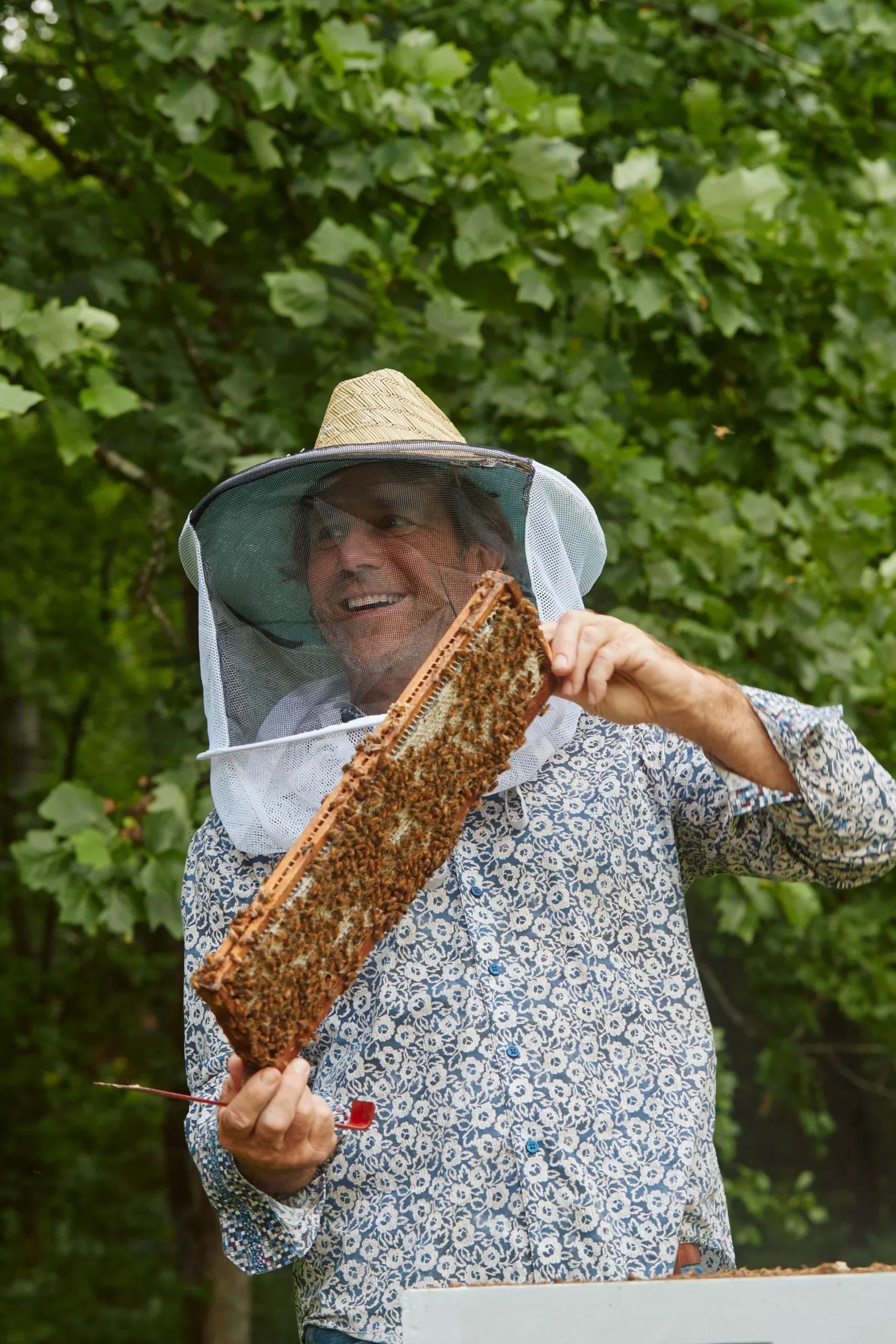
Ted Dennard, the founder and CEO of the Savannah Bee Company. Photo courtesy of the Savannah Bee Company.
Ted Dennard of Savannah Bee Company wasn’t necessarily a man with a mission when he started beekeeping. “I was sort of a hippie guy, not a business guy. I studied philosophy and religion,” he says. Things changed in 1999, when people started calling and requesting his bottled honey.
“I was just selling honey, like on the fly, while I was taking kids on wilderness therapy trips and resurfacing bathtubs and working all these jobs and wondering, ‘What am I going to do with my life? I need a career,’” he says. “2001 is when I made the decision to go full on into the honey business and just give it a try for one year to see what would happen.”
Today, the Savannah Bee Company boasts 16 retail stores across the United States selling everything from lip balm to mead to the gold standard of honey: Tupelo. It’s also supporting a global network of 100,000 hives.
Culture spoke with Dennard, who currently serves as CEO of Savannah Bee Company. Read on for his thoughts on honey, cheese, and everything in between.
Culture Media (CM): What are some common misconceptions about honey?
Ted Dennard (TD): [People] think that honey comes from pollen. It comes from the nectar of a flower, which is like a sugary water. It’s like the payment trough in a flower. Its only purpose is to attract and then kind of serve as payment for a bee or butterfly to come to that flower and cross-pollinate it with members of its own species so that it has genetic diversity.
I would also say that everybody thinks you have to eat local honey for health and allergies. I don’t necessarily believe that. It’s not that you couldn’t eat your local honey, but it doesn’t have to be your local honey, necessarily. I always say “support your local beekeeper—get raw honey, but if you can’t, then get a honeycomb.”
CM: So what’s the difference between filtered and raw honey?
TD: One: you haven’t killed the enzymes in raw honey, so it’s kind of like a living food. Two, typically if you’re going to [filter honey], you’re also going to filter out all the little micro pollens and some of the nutrients that would have otherwise been in there.
[With] a raw honey, it’s really a hard balance because everybody says, “I want raw.” But when honey granulates and crystallizes, nobody wants to buy it because it looks all yucky. Honey never goes bad, never spoils. It may not look as good, [but] it’ll probably taste exactly the same no matter what.
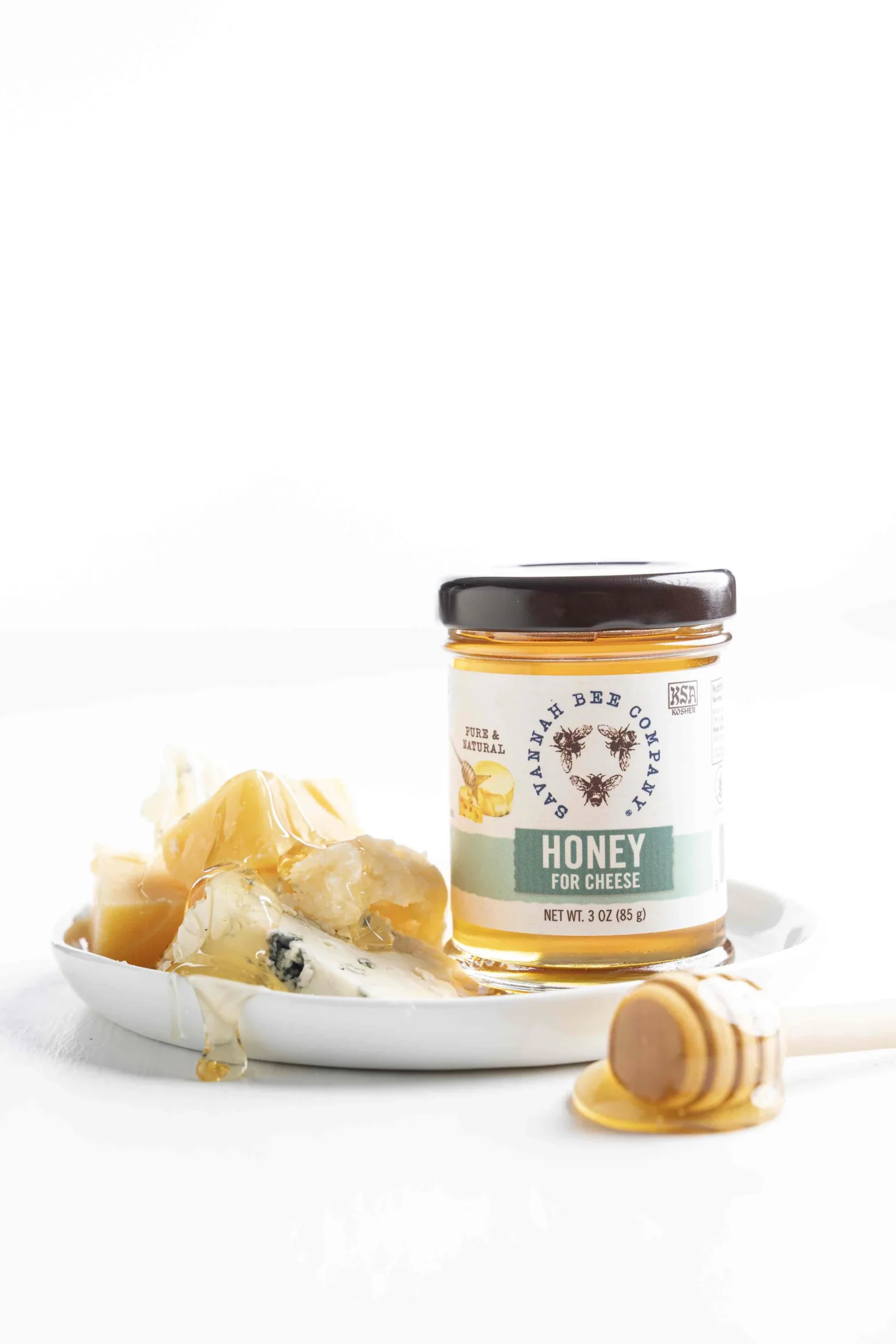
The Savannah Bee Company’s blend of honey for cheese, which pairs with Gouda among other cheeses. Photo courtesy of the Savannah Bee Company.
CM: How did you come up with the idea of making a blend of honey specifically for cheese?
TD: I do check myself a little bit because Tupelo honey is my favorite honey. But I don’t think it’s the best honey for cheese. I actually just experimented. It was really trial and error—like “this blend really goes well with cheese.” Most honey is going to do pretty well with cheese. But some is better than others!
CM: Do you work with cheesemakers to create perfect pairings?
TD: Sweet Grass Dairy—Jessica [Little] is amazing and has some wonderful cheeses which we sell in our little shops. Love her cheeses. The Thomasville Tomme is so good with our honey. We also work with Beehive Cheese Company out in Utah—they make Seahive.
The cheeses that I feel are the best with honey are an aged Gouda, a really sharp cheddar, or a younger Manchego. They’ve got real salt in them and there’s just something about the salty-cheese pairing with the honey that makes the perfect marriage.
CM: What’s your advice to aspiring entrepreneurs and/or artisans?
TD: I encourage everybody to go into business. I think it can be so rewarding. I feel like the luckiest person in the world!
Go for it if it’s something you really love because it’s going to be fraught with peaks and valleys and tribulations. But, if you love it and you have that passion for it, it’s like when you’re a winemaker or a cheesemaker: You have to go through that phase where you have to feel OK about selling your art. But then you get over that, and that’s just an exciting roller coaster, and you’re in control of your own destiny—you’re doing what you probably were meant to be doing. I feel like passion is a signpost telling you “Come this way.”
CM: What are your thoughts on mead?
TD: We have 16 retail stores and they all sell mead. And the guy that controls the mead says that mead is honey made more fun, or “adult honey.” But it really is a whole different experience— being the oldest form of alcohol, it’s completely a creative category.
Not unlike beer, where they do sour beers and this and that, with mead you can do so much with it. By adding different ingredients to it, as long as honey is the primary fermenting sugar, it falls under the category of mead. It’s super creative.
CM: How do you like to use honey?
TD: My personal favorite is, honestly, in my tea. The truth is that 90 percent of the honey that I consume is in a cup of tea. Normally, it’s a really strong black tea with milk and honey—Tupelo honey, of course.
This past weekend, I made a bunch of herb teas—a whole melange of different ones—and made a huge pot of tea with lemon, lime, and honey, and was drinking that over ice, which was super refreshing. So I’m basically just taking my everyday morning drink and turning it into an afternoon or evening drink too, without the caffeine.
I’ve really been getting into coffee, so I made my son a coffee, foamed the milk, and drizzled a little thin line of Tupelo honey on the foam. He’s like, “Man, this is really good.” So now I do that. I put it in fruit—like a raspberry upside-down—and fill it up. I’ll make that for my kids, and that’s cold, which is a good thing in the summertime too.
CM: What’s so special about Tupelo honey?
TD: It was really the foundation of the company. That’s when I decided, man, I’m gonna sell this honey, and I felt good about it.
It’s my favorite honey, not just for the taste and the soft, buttery, yummy sweetness, but it heals every wound I put it on. I don’t put anything on a wound except honey, and it’s always Tupelo honey.
I’ve tried Manuka. I’ve tried some other ones. Tupelo works the best for me. I jokingly say that Tupelo honey loves me as much as I love Tupelo honey. I’m talking wounds of 20-something stitches, whatever surgery. Like, it only has that honey, and it never hurts. It doesn’t get sore, it doesn’t get infected, it doesn’t scar—or almost no scar at all. So it’s just, I don’t know—for me, it’s like magic. It comes from an ecosystem that’s 50-plus million years old. Some of the trees are ancient, more than a couple thousand years old. All of that—the romance, allure, mystery, history, and just the ancientness—makes it incredible.
CM: What’s in store for Savannah Bee Company?
TD: What most excites me is what I’m titling “Beetopia,” which is this gigantic bee mural. I mean, it’s gigantic—20 feet tall on the sides of this new warehouse that we have. We’ve planted a half-acre with native flowering plants, and it was just a dirt lot.
Now we’ve got so many pollinators—different types and species of bees, butterflies, dragonflies—and it’s just working. We’ve created this pollinator-friendly habitat, this ecosystem for bees that really wasn’t there before. All pollinators are included. You even have wasps coming in, eating some of the things, but that’s all part of it.
I’m excited because I want to do tours there. I literally spent a couple hours today working on how we can get it open, just to get groups of people to come learn about bees, go outside in the hives, and experience it with this giant bee mural. They can learn about native bees, maybe build a little native bee house to take home.
We’re also launching a 100 percent post-consumer recycled plastic bottle. It used to be a water bottle. Now, it’s been molded into our honey bottle and we have a private little mold that’s real easy to squeeze. We are super excited to have that circular packaging with great honey to get out to as many people as possible.

Alana Pedalino
Alana Pedalino serves as Managing Editor of culture. Her work has been featured in Bon Appétit, Chicken Soup for the Soul, and more. She loves to write, cook, and kayak. Find her bylines at alanapedalino.com.