
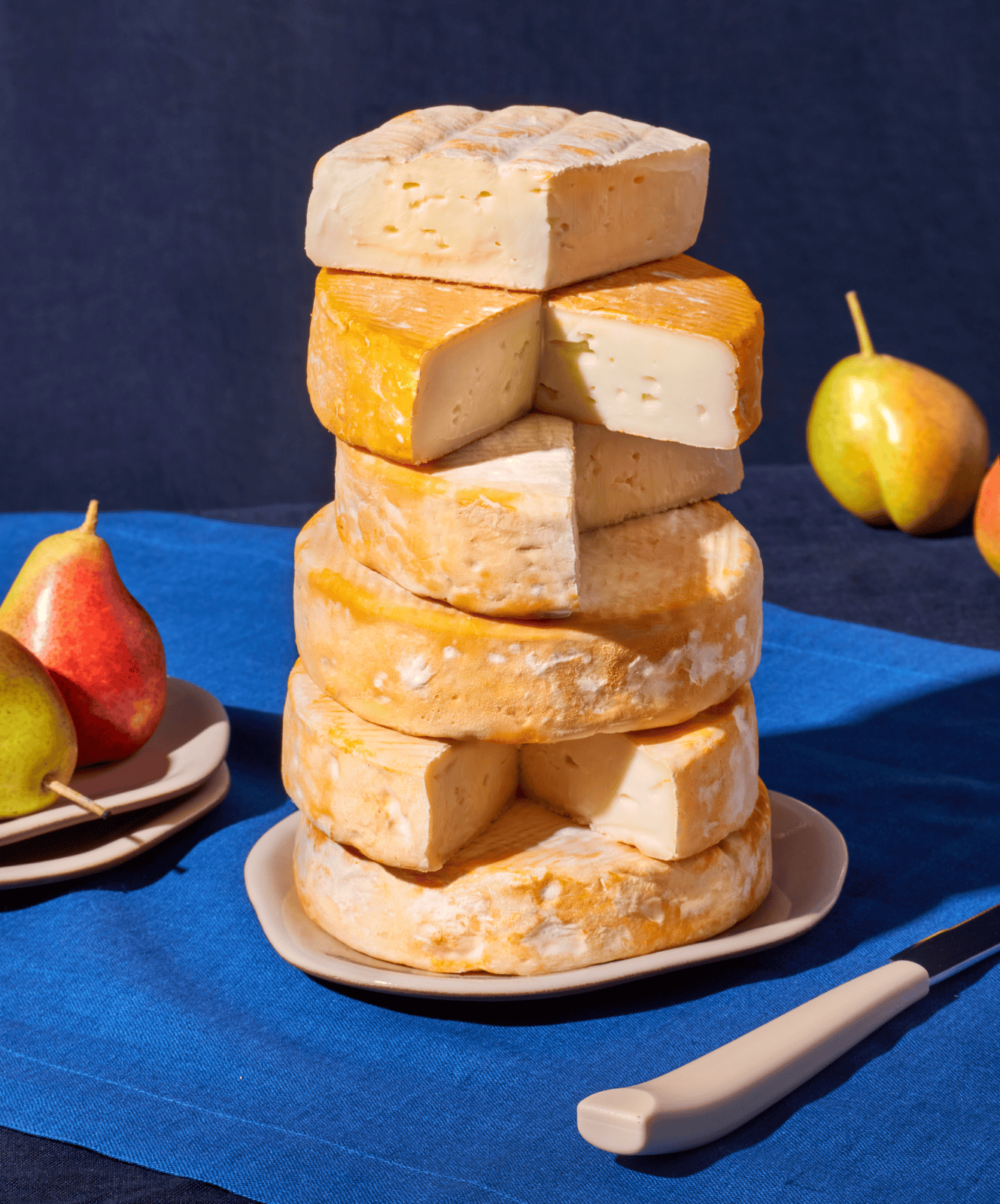
Photographed by Nina Gallant | Styled by Madison Trapkin
For a creamery built on bloomy rinds and triple creams, Golden Gate is a deliberate departure. Marin French Cheese Co. has spent 160 years perfecting fluffy white wheels, developing a reputation for its brie-style cheeses. Conceived in 2019 and launched in 2021, Golden Gate is Marin French’s only washed-rind cheese.
Golden Gate was born out of Marin French’s desire to try something new and a little playful. Hailing from Northern California—just across the Bay from the iconic Golden Gate Bridge—the cheese reflects the creamery’s heritage and a modern, adventurous spirit. “We wanted to create a washed- rind cheese that had personality—something fun with a nod to our region,” says Bonnie Kaufman, a brand manager at Marin French.
A triple cream made from pasteurized cow’s milk, Golden Gate is aged for14 days and hand-washed four
times. The first two washes include Brevibacterium linens; the final washed-rind devotees. It shines with little adornment—fresh baguette, fig jam, or apple and honey—and melts washes rely on brine alone. No annatto is used—the cheese’s vibrant orange color develops naturally. The process is labor-intensive,
especially since Golden Gate shares an aging room with bloomy rinds. Racks are moved daily, sometimes tray by tray, to manage airflow, temperature, and humidity.
“I always think of Golden Gate as this little underdog. It’s surrounded by these super aggressive bloomy-rind cheeses, and we’re trying to keep it from developing a bloomy rind,” Kaufman says. “It requires constant vigilance.”
When young, Golden Gate is mild and fudgy; with age, it deepens into a savory, meaty, umami-driven cheese with vegetal notes and a silky, spreadable paste. The added cream tempers the funk, making it approachable for the stink-curious while still rewarding washed-rind devotees. It shines with little adornment—fresh baguette, fig jam, or apple and honey—and melt beautifully when baked. For one of America’s oldest cheesemakers, Golden Gate is proof that tradition and evolution aren’t opposites—they’re partners.

Josie Krogh
Josie Krogh is culture's Digital Strategy Lead. She earned her master's degree in Agricultural and Applied Economics from The University of Georgia. Josie developed a love of food while working at farmstands in the D.C. area as a young adult, and discovered her love of cheese while living and working on a dairy farm on Martha's Vineyard. Josie currently lives in Catskill, NY.