
Plus, why hard cheeses don’t always have tyrosine crystals
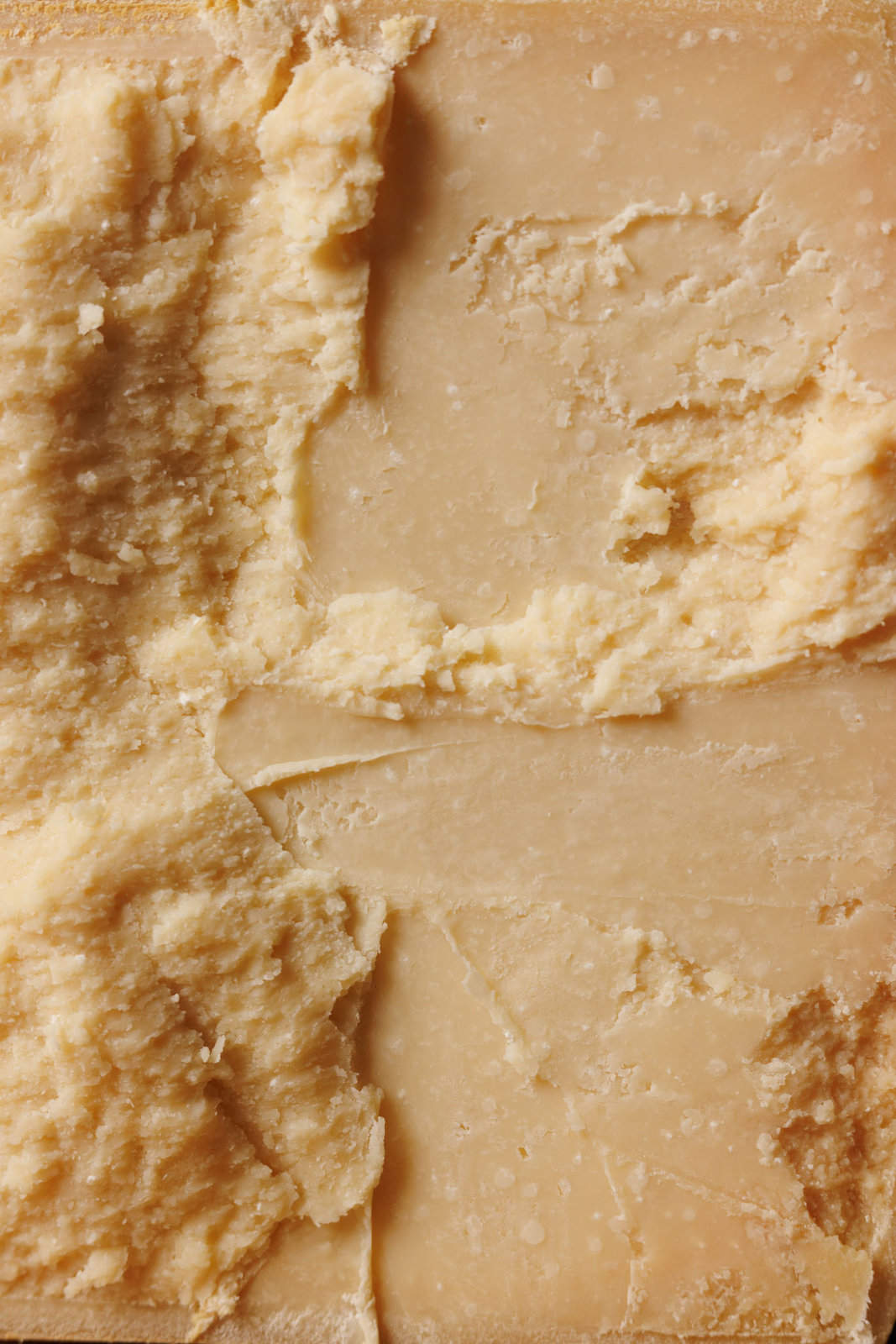
A close up of the interior paste of Parmigiano Reggiano. Photo by Adam DeTour.
In the ancient Mediterranean, stone was fearsome. When Battus snitched on Hermes for stealing Apollo’s cows, he was turned to stone. From Medusa to Poseidon, Greek mythology is rife with stories of revenge by petrification. Lacking clothbound cheddars and aged Alpine rounds, it is understandable how the ancient Greeks could overlook the joys of stonification. But for cheese lovers, the unexpected stony crunch resulting from the phenomenon often referred to as “flavor crystals” is a certain delight.
Technically, stones are composed of many different minerals that are combined through various geological forces. Minerals are structures of inorganic compounds (lacking carbon) that often take the form of a crystal (having an ordered and repetitive structure). Numerous crystals form in cheese, from the imperceptible brushite of bloomy rinds to the sandy ikaite and struvite of washed rinds. Many of these are mineralized crystals that have not been subjected to the extreme forces that would transform them into rocks. They remain just the building blocks of stone. Calcium lactate, the white layer that forms on the surface of a cheddar, is an example.
Yet, the most distinguished of cheese crystals, tyrosine, is not a component of stone but a foundation of life itself. Tyrosine crystals are the crunchy starbursts found in the paste of many Alpine-style, Italian, and Dutch cheeses. They are formed from the amino acid of the same name, which is an organic compound and therefore not a mineral. The lithic similarity in texture between tyrosine and calcium lactate comes from their crystalline structures.
Two things are needed to make a crystal: building blocks that can link together to form repetitive structures, and energy to create that connection. When the energy is low, an overabundance of the building blocks is needed before a crystal can form. To borrow an analogy from the late cheese scientist Pat Polowsky, if a box of Legos is shaken rapidly, more bricks are likely to attach to each other if there are more bricks in the box at the start. Taking the analogy further, if I shake the box timidly, it will need to be shaken longer before the bricks will link.
Tyrosine is one of the amino acids that comprises casein, the protein found in milk, and gets its name from the Greek word for cheese, tyros. It is thought that (though not fully understood) the lactic acid bacteria Lactobacillus helveticus is responsible for freeing up the tyrosine in the previously mentioned styles. This starter culture was first isolated from an Alpine cheese and is now added to many styles to impart sweetness. It is especially well-equipped to break down protein into its constituent amino acids. When L. helveticus is present, over time it will free up enough tyrosine for it to “shake” together and form a crystal. As the cheese ages, more crystals will form and grow, transforming proteins into crunchy bits.
Perhaps we have misinterpreted the myth of Medusa for centuries, and her petrifying gaze was actually an allusion to the complexity of aged cheese, not certain death.
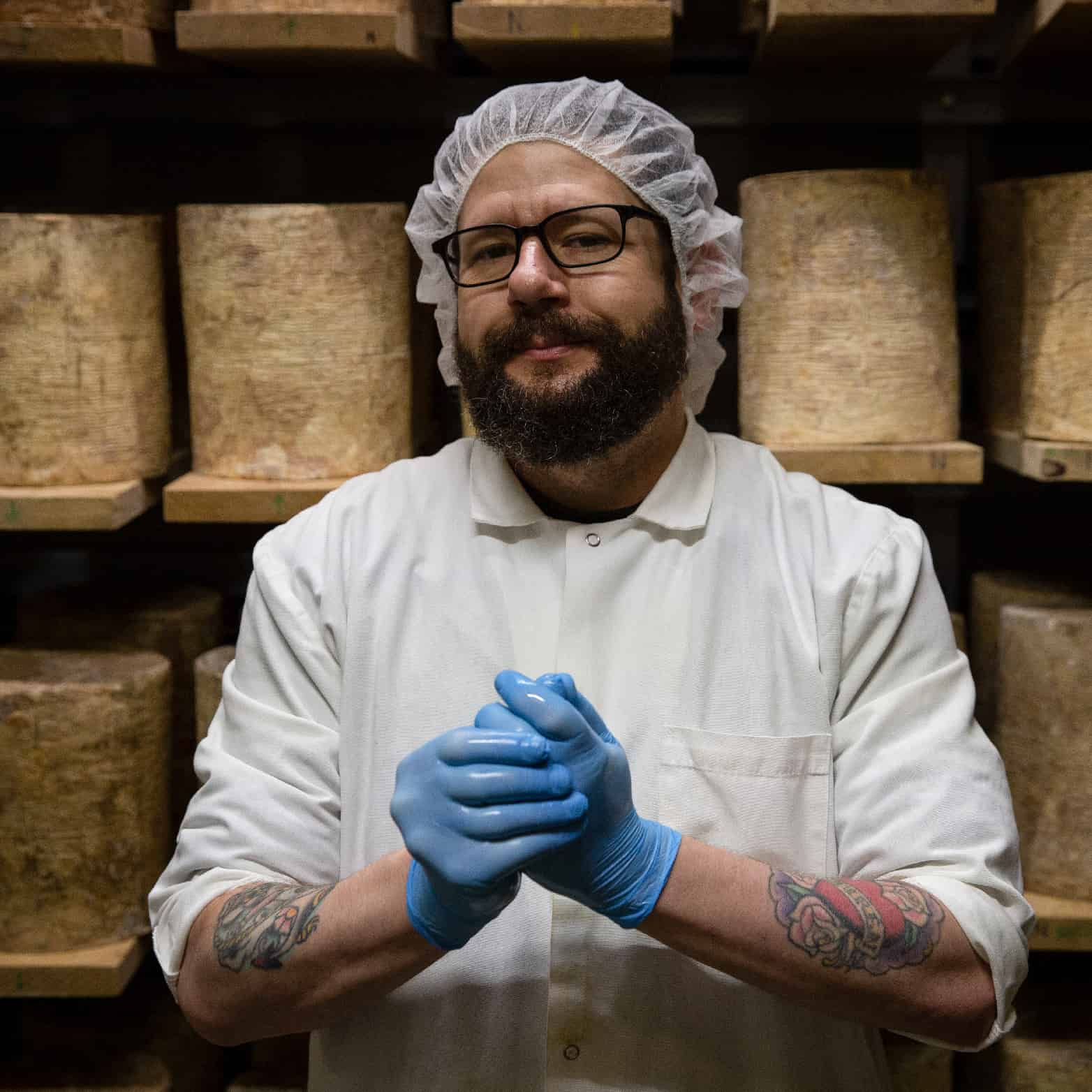
Josh Windsor
Josh Windsor is an affineur and the Senior Caves Manager at Murray’s Cheese in New York City, where he actively nurtures and ages the Cave Aged line of specialty cheeses including the 2019 American Cheese Society (ACS) “Best in Show” winner Stockinghall Clothbound Cheddar and the 2022 World Cheese Awards “Best American Cheese” winner Greensward. Always curious about how cheese ages, Josh is an active member of the community biology lab, Genspace, where he explores the microbial world of cheese rinds. Josh shares his love of all things dairy by teaching cheese appreciation, science, and history at Murray’s Cheese and sensory evaluation at Cornell University’s cheese short courses.