
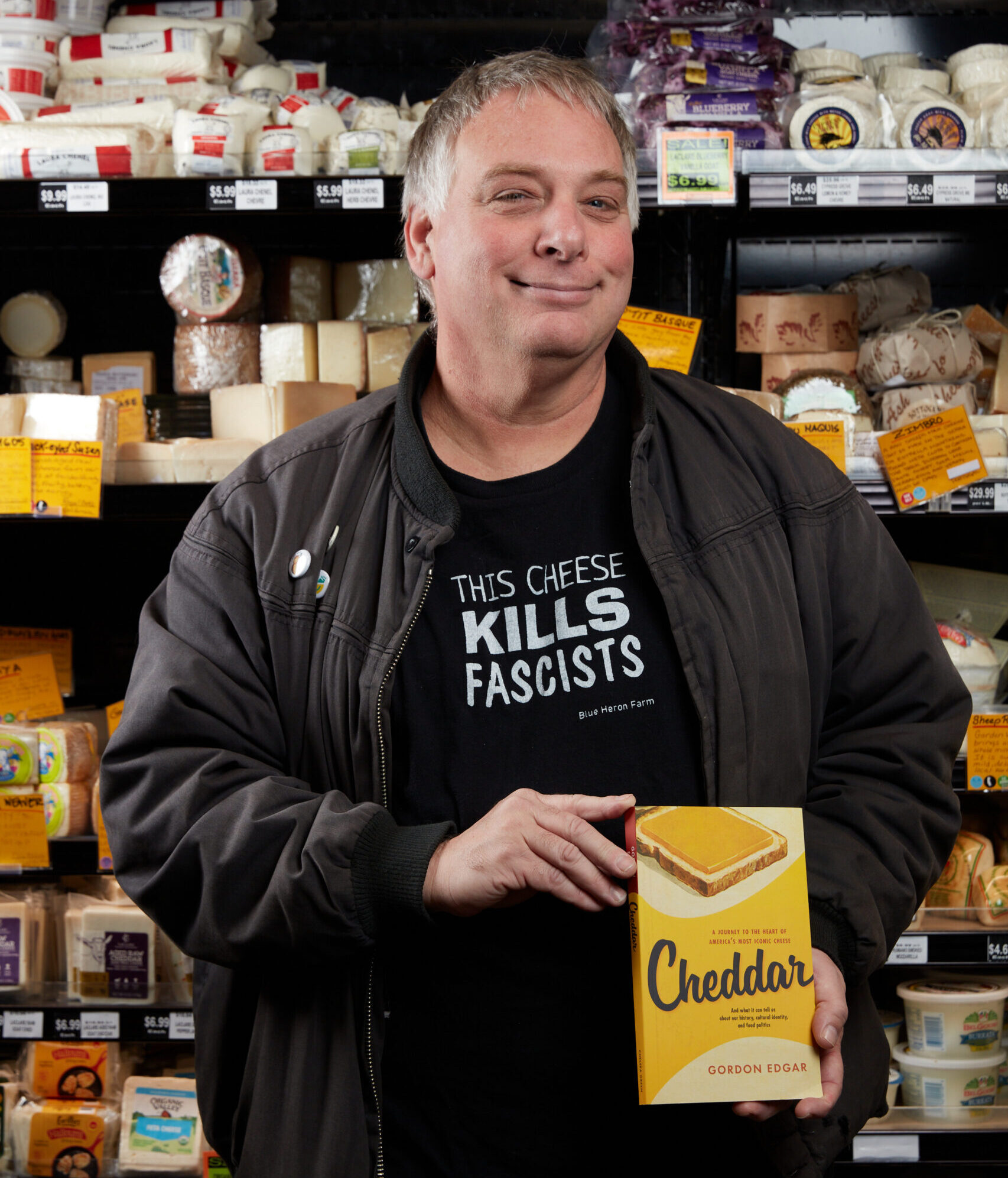
Gordon Edgar is many things: the cheese buyer for San Francisco’s Rainbow Grocery Cooperative, one of the most prominent worker-owned grocery stores in the US; the author of several books, including one on cheddar cheese, aptly named Cheddar; and a longtime Californian with a love of punk rock and Teleme, a legendary Bay Area soft-ripened cheese. He’s also the recent winner of the American Cheese Society’s Meritorious Service Award, which honors cheese professionals who better their community. It’s safe to say this was a highlight of his 30 years in the biz. “I cried,” Edgar says. “It’s really nice to be recognized by peers. It meant something to me.”
We spoke with Edgar about mentorship, the long-term sustainability of co-op models, and the ways in which the cheese world historically parallels the DIY music scene.
culture (CM): What makes cheese punk rock?
Gordon Edgar (GE): When I first got involved in the cheese world, I would ask which cheese people I should visit before I would travel anywhere. A lot of times, they didn’t live close to places you could rent a room at, so they would let you sleep on their couches.
Like the punk scene I grew up with in the ’80s, the cheese scene had regional styles. Different cities and different places had different scenes, and some punk scenes might be more melodic, some might be faster, and some might be political. Before a lot of European companies started buying American companies, there were these regional cheese scenes, and it felt similar in a way. There’s also something very similar about the creation process. People wanted to make a living, but money wasn’t the priority. They wanted to express themselves. They wanted to do something that was important to them and share it with others.
CM: What made you fall in love with cheese?
GE: When I first started out, I was fascinated by how much there was to learn. Also, the fact that people who had been in the business for a long time admitted they didn’t know everything and were still learning. That seemed like a really great place to be in—a place where you could constantly discover new things.
CM: What are your thoughts on the American cheese scene and where it’s headed?
GE: It’s gone from American cheese not being respected and nobody knowing about it—like it’s almost totally underground—to being something that is respected and people are like, “You need to get these cheeses from the US.” Not only are you supporting local things, but these are now some of the best cheeses in the world.
A lot of those folks I met when I first started out have retired. Their companies sold to more faceless, less interesting companies. While I think there are always new, exciting things and cheesemakers coming along, I feel like there used to be a lot more characters, and I kind of miss that. As a buyer, my job is harder now than it used to be—sure, you can go to a website and find basic information, but you don’t have anyone to talk to who knows anything about cheese. Your contact with a company is just a sales rep. I find that discouraging. But again, there are always new people making more interesting cheeses who you can talk to.
I guess it’s a maturation process. American cheese is becoming more stable, but it’s a little less interesting now. I don’t know. I hate to say that. I mean, I work at a cooperative. We saw those freaks start from making cheese in their barns to growing into companies. Being weirdos ourselves, we found it entirely up our alley. There’s just a little less of that these days. A lot of these cheesemakers started as hippies. We were on the same wavelength.
CM: How has your role as a cheese professional changed as San Francisco has changed?
GE: One thing I love about my job is being out in the public and seeing people in the community every week. I have regulars, and it just feels important. Being in a tech-forward city, there’s a devaluation of face-to-face contact. People embrace online shopping, and giving an Instacart shopper a taste of a fancy cheese is useless—they’re not going to buy it, they’re buying the cheese that’s on their list. As San Francisco has gentrified, the community has changed. There aren’t as many people who can work at a grocery store and afford to live here. Rainbow Grocery pays what it can, but there’s a limit to small business margins.
CM: What is the role of mentorship in today’s industry?
GE: I try to help people when I can, and I’m available to talk. I don’t necessarily have more to offer than that. But I’m happy to talk. Creating space for BIPOC folks has also been a big priority—those who historically haven’t been represented in the cheese industry. They like cheese. That’s super important.
CM: What about advocacy for cheesemakers and creameries?
GE: The job of a cheesemonger is to explain why cheese costs what it does. Urban people don’t know how rural people live. Someone comes to the counter asking, “Why is this so expensive?” You explain the pressures makers are under, how long cheese takes to make, how tricky it is. How, if a batch doesn’t come out, the makers are screwed but won’t know they’re screwed for months. Communicating between different cultures is a big part of the job.
CM: How does the co-op model fit in modern times?
GE: It’s tricky because there are many co-op models, and I don’t think ours is replicable because we grew at a very specific time in a very specific city—and we had a little luck. We made some smart decisions, too. But we went from being this tiny hippie buying club to being the largest independent store in San Francisco. Our timing was right—we bought a building before national chains moved in, and we’re in the natural food world, which became really popular. If somebody was starting a co-op now, I don’t think they would do it the way we did.
I think our future as a country has to be more cooperative than it is now. How we’re living is horrible and not sustainable. There are long traditions of cooperation in this country—co-ops, consumer co-ops, worker co-ops, Employee Stock Ownership Plans. I think they’re all leading to better outcomes than what we currently have. Two of the longest-lasting and biggest American cheese companies are cooperatives—Tillamook County Creamery Association and Cabot Creamery. They’re not direct democracy cooperatives like Rainbow is, but they’ve managed to last 100 years or so, and that’s worth noting.
CM: What is a common misconception about American cheese?
GE: For the Boomer generation, it’s that it’s not good enough. It doesn’t stack up to European stuff. But I think that idea has gone by the wayside. When I started, people didn’t even want to hear about American cheese. I mean, there’s a reason for that—American cheese wasn’t very interesting. It was all factory-based rather than having roots in a small-scale artisan model. But I think that’s changed.
Besides that, just that it’s overly expensive. There are reasons cheese is expensive, and if you look at the number of cheese places that go out of business each year, you’ll see that it’s a tough business.
CM: Has cheese helped you through grief?
GE: Yeah. Grief is universal. I’ve had some really special moments with people. My wife, Laurie, got sick and suddenly died—there was no long period of knowing she was going to die. Before she passed, I had made one of her favorite things, carnitas, but she wasn’t up for eating, so I froze them.
A few months later, a bunch of cheese people were in town. I invited them over, unfroze the carnitas, re-crisped them, and made it a meal for everyone. It was, in many ways, L’s last meal because I had cooked it for her. It was an incredible moment—I grew up in the Bay Area, and here were these people from all over the country who I’ve met through cheese who I was sharing this intense but kind of awesome moment with. It was really touching. Some of them I had known for 20 years in the business … when you’re talking about grief and death and loss, it really breaks down those barriers. On that level, cheese is another point of connection.

CM: Which cheese do you turn to in tough times?
GE: Teleme. That’s my favorite cheese in the world. It’s a real Bay Area tradition. You couldn’t grow up in Northern California in the ’70s and go to an Italian deli and not see Teleme. You can’t get it anywhere else. I probably buy it every week. It goes with everything. It’s the ultimate table cheese.
CM: What is the American spirit as it applies to cheese?
GE: Because there was such a rush to embrace factory production, it created this whole generation of boring cheese. But I feel like that also opened the doors for people who wanted to make interesting stuff to not be constrained by tradition or regionality. If they wanted to make a certain type of cheese, they could figure out a way to do so if they were passionate enough. It’s been wide-open for creation and innovation.
CM: When you look back over your career in cheese, what do you think you would have told your younger self?
GE: In those early days when I didn’t know anyone, I probably would have told myself, “These people are great. Hang in there until it gets easier,” which I did, but I didn’t have anybody reassuring me.
And protect your body. If you’re working the physical part of cheese, learn about ergonomics right away and protect yourself. Surround yourself with good people, not businesspeople, because there are a lot of good people in the cheese world, and we’re all doing business.

Alana Pedalino
Alana Pedalino serves as Managing Editor of culture. Her work has been featured in Bon Appétit, Chicken Soup for the Soul, and more. She loves to write, cook, and kayak. Find her bylines at alanapedalino.com.