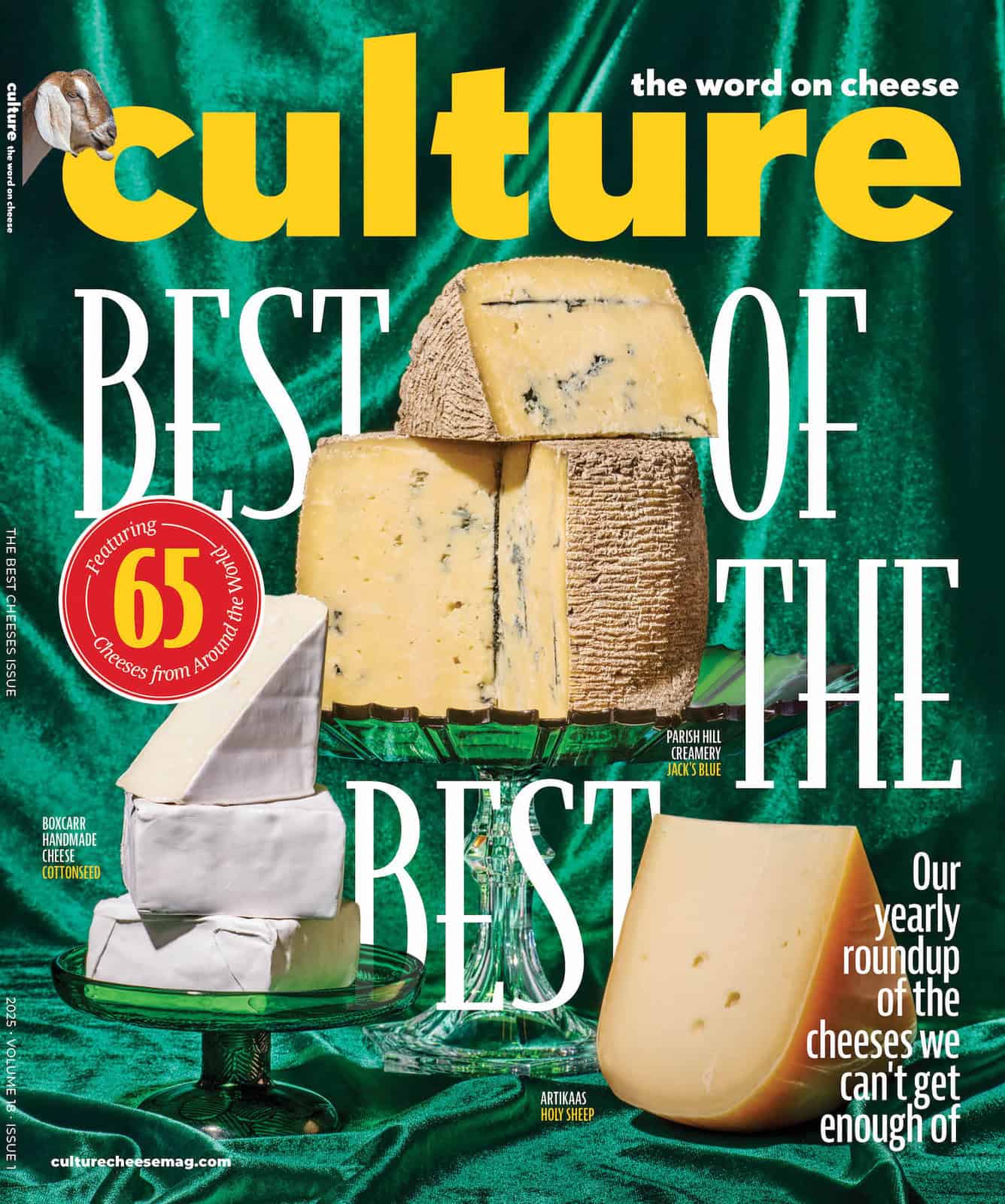


Andy Hatch is a legend in the American artisan cheese world. As head cheesemaker and co-owner of Uplands Cheese in Dodgeville, Wisconsin, he’s responsible for two of the most celebrated cheeses in the country: Pleasant Ridge Reserve and Rush Creek Reserve. A passionate steward of place, process, and flavor, Hatch has built a farmstead model that’s both traditional and quietly radical—one where the land, animals, people, and product are all in symbiotic balance. We spoke with him about falling in love with cheesemaking on a Norwegian fjord, the unique spirit of Wisconsin terroir, and why the future of artisan cheese is more precarious—and more hopeful—than ever.
culture (CM): How did you get your start in cheesemaking?
Andy Hatch (AH): I couldn’t figure out how I was going to make a career in farming work, so I thought maybe I’d go back to school for ag research. I was applying to grad school and working for a corn breeder at the time. He had married into a Norwegian cheesemaking family, and when his elderly father-in-law passed away, they sent me—this 22-year-old kid—off to Norway to help his mother-in-law, this little woman named Moony who lived on a farm on the side of a fjord. No car, no phone, no Google Meet.
I’d grown up in Wisconsin and worked on dairy farms, but I hadn’t made cheese until I went to Norway. I made goat cheese with Moony, and right away it clicked. It made sense to me. It’s kind of like lab work—structured, scientific—but with this tangible, deeply satisfying product at the end of the day. It felt good. I could see how, economically, cheesemaking could be a way into dairy farming. You’re not going to get rich, but if you can add value to milk, you can hopefully afford to farm.
CM: What made southern Wisconsin the right place to build Uplands Cheese?
AH: I spent several years as a cheesemaking apprentice in different parts of Europe—Italy, France, England, Norway—and I gained so much appreciation for how seriously they take tradition. There’s this huge infrastructure built around it: universities, veterinarians, equipment suppliers.
In Wisconsin, our tradition isn’t as deep—it’s maybe 150 years—but there is a legacy, and more importantly, there’s this incredible density of infrastructure and a progressive spirit. We’re not as constrained by PDO rules. In Europe, I couldn’t have just decided to make a cheese like Pleasant Ridge Reserve out of nowhere. I’d be told to make Gruyère and follow exact specs—how many wheels, what size, what shape.
Here, we have the freedom to combine tradition with innovation. That, plus the climate, soil, and pastureland—there’s really no better place in the world to milk cows and make cheese.
CM: You’re a true farmstead operation—milking, making, aging, and selling all on site. Why did you choose to do it all in house?
AH: Control. Quality control, ultimately. When you manage every part of the process—from cow breeding and pasture management to how the cheese is made and sold—you can ensure everything is working toward the same goal. That’s hard to do when you’re passing milk or cheese between entities.
It’s not easy. It’s a complex operation, and it creates limitations for scale. But it also creates huge opportunities for quality. And I think it gives meaning to the work. Dairy farming and cheesemaking are physically demanding and repetitive—there’s real risk of burnout. But when our farmers see their milk become something people appreciate, and when our cheesemakers feel the rhythm of the seasons in their work, that creates purpose. The cheese isn’t disappearing into a factory system—it’s staying with us. That matters.

CM: Let’s talk about that seasonality. Pleasant Ridge is only made during grazing months, and Rush Creek only made in the fall. Why?
AH: Pleasant Ridge is made while the cows are on pasture—spring, summer, and early fall. The flavor of grass-fed milk is complex, but it takes time to develop in cheese. That’s why we age Pleasant Ridge for many months; it’s like letting a red wine age.
Rush Creek is made at the end of the grazing season, when the cows are transitioning to a winter hay diet. The milk is heavier, fattier, and a little less complex. That’s perfect for a rich, soft, unctuous cheese.
We didn’t invent this approach—it comes from Alpine cheesemaking traditions. In the summer, you make firm cheeses to age. In the winter, when the cows come down from the mountain and eat hay, you make soft cheeses. We’re just following that seasonal logic with the tools and milk we have.
CM: You’ve talked before about balancing innovation and tradition. How does that play out in your work?
AH: Even in Europe, where tradition dictates a lot, cheesemakers are always refining things—cow genetics, soil health, techniques. In the US, we have even more freedom. We can change the size or shape of a cheese. We can experiment.
Take Rush Creek. When I learned to make Mont d’Or in the Jura [region], it was sold young—maybe 30 days old. But here in the US, because it’s raw milk, we legally have to age it at least 60 days. Early on, I saw that as a handicap. That extra aging made it risky. It could over-ripen or develop problems.
But over time, we learned to coax something new out of it. The flavors became more meaty, savory, umami-rich—totally different from the delicate, milky Mont d’Or I’d known. So, what started as a constraint actually led us somewhere more interesting.

CM: Is it possible to grow a business like yours? Or is farmstead cheesemaking inherently limited in scale?
AH: We’re debt-financed. We don’t have investors or family money, so we’ve had to grow slowly. And farmstead growth is slow by nature. If we want to make more Pleasant Ridge, we need more heifer calves, which means waiting for them to grow, calve, and start producing milk—and then the cheese has to age a year. You’re looking at a three-year timeline.
We’ve grown 4 to 6 percent a year. A few more cows. A little more cheese. But pasture-based dairy has its limits. Our cows can only graze so much land. It’s like a vineyard that yields a fixed number of grapes.
We were lucky: two neighboring farms sold us land on incredibly generous terms—land contracts, interest-only—because they believed in what we were doing. That’s given us the ability to expand. But now, our facilities need upgrading to match, and that’s a serious investment. Land, animals, aging space—it’s capital-intensive, and it’s hard to finance that kind of growth.
CM: How does sustainability fit into your model—ecologically, economically, and socially?
AH: Pasture-based dairy is a beautiful closed loop. You need enough acres to feed your cows, and the cows fertilize those acres in return. You build soil. You protect water. You support biodiversity. This is how the Great Plains were formed—animals grazing perennial grasses.
It’s better for the cows, too. And that grass-fed milk has extraordinary flavor. Flavor translates to value. That’s the only way a farm like ours survives—by creating something that’s worth more than the sum of its parts.
We spend about $1 million a year in our community. That’s feed from neighbors, labor, vet care, electricians, plumbers. It’s not nothing for a town of a few thousand. Cows and cheese have long been a vehicle for wealth distribution in Wisconsin—90 percent of our cheese leaves the state, but the money comes back.
CM: You’re one of the people who helped build the US artisan cheese movement. What’s your take on where it stands today?
AH: There’s real reason for optimism. More people are eating better cheese than ever. And once you’ve tasted the good stuff, you don’t go back.
But there are challenges. Consolidation across the supply chain. Rising land and labor costs. It’s harder than ever to start a small cheese business, especially a farmstead one. That’s a problem—not just for our industry but for farming more broadly. Cheesemaking is a proven way to save family farms.
So, what do we do? Some forces are out of our control. But we can invest in people. We host five or six apprentices every year—cheesemongers, farm kids, people figuring it out. That’s how I learned, and it’s still the best way. We pass it on.

Hannah Howard
Hannah Howard is the author of the memoirs "Feast: True Love in and out of the Kitchen" and "Plenty: A Memoir of Food and Family." She writes for The Guardian, Bon Appetit, and Wine Enthusiast and teaches writing classes online. Howard lives in New Jersey with her family and loves stinky cheese. Photo credit: Tiffany Simone.