
A Q & A with the President & CEO of Norseland, Inc.
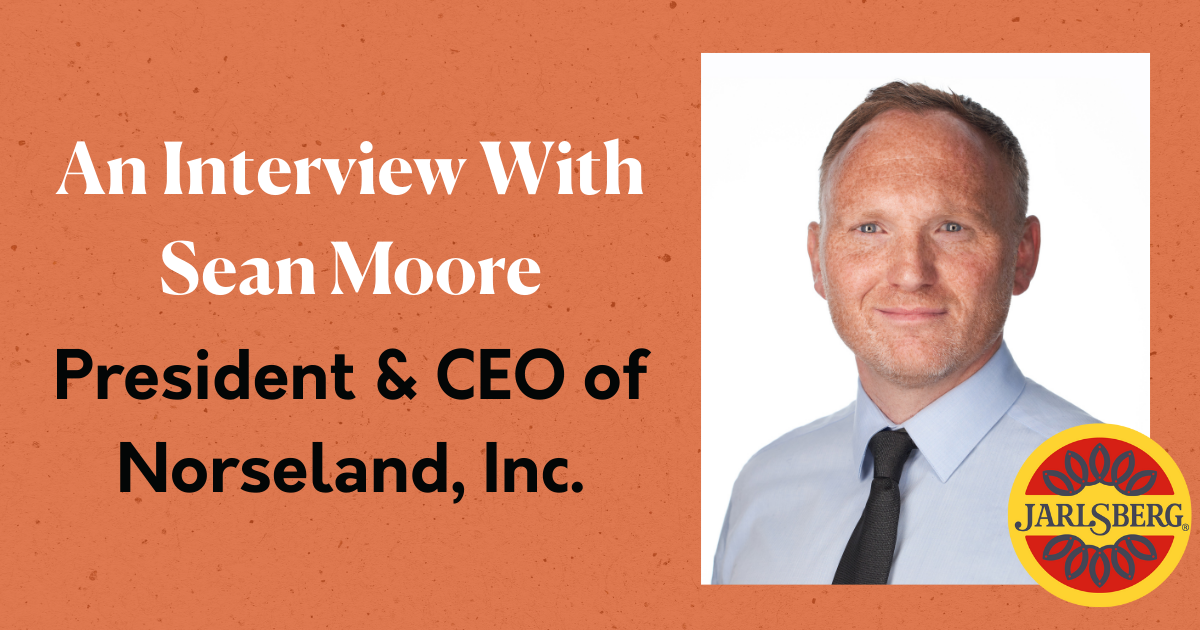
At Norseland, Inc.—the Scandinavian company behind mild, nutty, and utterly snackable Jarlsberg—you’ll find Irishman Sean Moore at the helm.
This makes a lot of sense when you think about it. Moore grew up milking cows on a dairy farm. Over the course of his career, he’s also helped Americans fall in love with imported products. “I came here in 2003 and I was the first of three people to come to the US with Kerrygold,” he says. The rest is butter history.
His latest undertaking is the reintroduction of Jarlsberg to a new generation. “Although it was out there in every single store, I felt like Jarlsberg needed a rebirth,” says Moore. “The story needed to be told to so many people.”
Read on to discover what makes Jarlsberg unique in today’s dairy landscape, how this foreign cheese supports domestic microeconomies and farmers worldwide, and ways to eat the Norwegian staple.
Culture Media (CM): What attracted you to Jarlsberg?
Sean Moore (SM): Besides the brand, what attracted me was TINE, the parent company. It’s Norwegian and it’s owned by 7,000 farmers. Coming from a farming background, that really resonated with me.
The sole purpose of TINE is to keep the farmers on the land in the community. I got to understand their goal. It wasn’t just a commercial goal, but it was also this community-based spirit. TINE has a social responsibility to collect every gallon of milk produced in Norway. So even if you’re a little farmer on the northern islands of Norway with 10 cows, TINE will send a truck there every week to collect your milk. That really stuck with me being from a small village.
CM: I was surprised to learn Jarlsberg is produced internationally. What is the reason for that and how does it occur?
SM: Jarlsberg is produced in three countries: Norway, Ireland since 2018, and in the United States since 2000.
The reason for that is we have decided that we want to make sure we can secure supply. In Norway, of course, we have a large supply of cow’s milk, but it is limited and if we want to grow internationally it’s [about] getting access to a similar country. Norway shares a lot of geographical likeness to Ireland. It’s a big grass-based system. Ireland’s a very trusted country in terms of milk supply. Ireland is also part of the EU, which gives us broader access to the globe and particularly the US.
In Ohio, we produce our cheese in a small town called Winesburg. It is one of the largest producers of Swiss-type cheese in the United States. Out there, we have about 40 people and we purchase our milk from Dairy Farmers of America, so we support local farmers. All our milk is collected within about 100 miles of the plant. As we continue to grow our business in the United States, our goal is to purchase more US milk and to employ more people within our Ohio facility.

CM: Jarlberg’s latest campaigns and commercials are centered around the idea of reintroducing Jarlsberg to a new generation. Why?
SM: Cheese is having a cultural moment. There’s so much content out there now, it’s making cheese part of the conversation. I think something in that is quite exciting. It’s also one of the categories of food that is approachable.
Jarlsberg is uniquely positioned to re-enter this spotlight. Although it’s been around for decades, its versatility and unmatched flavor is something that needs to be rediscovered. We are a classic cheese, but we don’t want to be safe. We want to lean into the emotional reaction that people have when they have cheese. It’s that aha moment that you have when you have this cheese, and particularly if you haven’t had it in a long time, that exists in our recent campaign.
It’s multigenerational as well. Whether you’re a student or you’re a young professional or you’re a mom or a dad or whatever generation you’re in, you can have that same reaction to it. Jarlsberg has nostalgia attached to it. There is this whole thing of rediscovering it for yourself and making new memories together as it’s passed down from generation to generation. It’s iconic, too.

CM: What do you love about this cheese?
SM: It’s a beautiful-looking cheese. It’s smooth, it’s creamy, the texture is fantastic. It’s versatile in that you can use it to cook. It melts extremely well. You can do so much with it.
It’s visually appealing. If you see that pull when you have a toastie, that is quite beautiful—that visceral reaction that you have to it. Jarlsberg crosses so many different boundaries, but appeals to everybody.
CM: Jarlsberg is a specialty artisan cheese, but what has made it accessible for so many years?
SM: We’ve been around in the US for nearly four decades. I think we were part of the group of cheeses or brands that built this category. Today, we’re in 25,000 stores. Our broad availability across the United States makes it accessible. It’s also seen as an affordable cheese within that category. Jarlsberg doesn’t need a complex recipe—you can make staples like mac and cheese. I think that’s part of its wide appeal: You don’t have to be an expert in cheese to absolutely love ours.
CM: What makes Jarlsberg stand out in the cheese case?
SM: Jarlsberg is an anchor cheese and it’s a classic. People will always pick up flavored cheese and everything else, but Jarlsberg is that cheese that can be used every day. It gives cheesemongers’ customers that comfort that they know they can rely on—they won’t be disappointed when they take it home. It’s an everyday cheese that can be used in multiple ways and every meal. It can be a centerpiece on a cheese board. It also can play a role in Tuesday night pasta.
It’s also a wonderful starter cheese, but it has an incredible complexity to somebody who knows cheeses extremely well—that sweet and nutty taste. [Plus,] it comes from grass-fed cow’s milk.

CM: Jarlsberg recently updated its packaging. What was the rationale behind the change?
SM: We wanted to get back to the basics and talk about exactly what the cheese is. So, we focused on that iconic logo and wheel. We called out the key highlights on it and what consumers actually care about: grass-fed, good source of protein, naturally lactose-free.
We want to have maximum shelf impact. You want to see this product from far away. We wanted people to be able to find us. Jarlsberg stands by itself and this new logo is part of this overall campaign that we’re running to make our product more physically available to our consumers.
CM: What do people get wrong about Jarlsberg?
SM: It’s actually not a Swiss cheese. It has a sweet and nutty taste of a gouda, but has those distinct holes that are reminiscent of a Swiss. So, it’s this hybrid cheese that delivers that visual impact of a Swiss and that beautiful sweet and nutty taste and meltability of a gouda. I think only Norway could come up with—it’s art and science coming together.
What I’m most proud of is the fact that our cheesemakers are able to deliver a consistent product and reliable experience for the consumers. That’s a major feat and a major investment—not just in technology but in those people.

Alana Pedalino
Alana Pedalino serves as Managing Editor of culture. Her work has been featured in Bon Appétit, Chicken Soup for the Soul, and more. She loves to write, cook, and kayak. Find her bylines at alanapedalino.com.