
A cheese professional’s sense of smell is their superpower. What happens when it disappears?
When Tracey Johnson was invited to judge the British and Irish Cheese Awards in early 2025, she knew she’d hit a career milestone. For the UK-born, British Columbia-based cheese educator who runs home cheesemaking supply company Cheese Needs and teaches courses at the Academy of Cheese, it felt like recognition for the years she’d spent developing her palate and honing her senses—and it was a key step toward her goal of judging at the World Cheese Awards.
Not long after arriving home from her travels, Johnson picked up a bad cold that knocked out her sense of taste and smell for six weeks. But it lingered even after her other symptoms had resolved. “My taste was gone completely,” she says. “I could put chili in my mouth and I wouldn’t know it was there. I literally couldn’t taste anything.”
Johnson was experiencing anosmia, the loss of smell, and ageusia, the inability to taste. These chemosensory disorders can be devastating for anyone and seriously impact quality of life, personal safety, and mental health, but for those who rely on their senses for work—chefs, restaurant critics, sommeliers, cheese experts—anosmia and ageusia can have profound ramifications.
MISUNDERSTOOD FOR MILLENNIA
Sense of smell is the least understood of the senses yet it profoundly impacts how we experience the world: Our ability to smell has evolved over millions of years to protect us from potential harm—fire, gas leaks, spoilage. It also affects how we experience flavor.
“Taste is sensed by the taste buds on the tongue and soft palate,” says Hong Wang, a molecular biologist and member of the Monell Chemical Senses Center in Philadelphia. “Olfactions are sensed by the olfactory sensory neurons up in the nose, then integrated in the brain together with taste as flavor.”
Along with hyposmia (decreased sense of smell), parosmia (distorted sense of smell), or phantosmia (smelling things that aren’t there), anosmia occurs when the delicate olfactory nerves are damaged. These conditions have received more public attention since 2020, when COVID-19 began to cause loss of smell and taste for many. A 2025 study published in JAMA Network Open found that 80 percent of subjects who reported loss of smell after having COVID had hyposmia based on clinical tests, while 23 percent had severe or total loss of smell.
Anosmia or hyposmia after a viral infection is often temporary, but loss of sense can stick around for years—or forever. Steve Millard, an industry veteran who spent a decade as senior vice president of merchandising and operations at Murray’s Cheese, was working as an independent consultant when COVID completely took away his sense of smell for about six months. “Being in the food business for so long, I spent a lot of time sharpening my sense of smell and taste,” he says. “To suddenly have that gone, I was like, ‘Is this the end of my career?’”
Now general manager at Acme Smoked Fish, Millard estimates that his sense of smell is about 80 percent what it once was, though his ability to sense heat from spicy foods is completely gone, and he occasionally experiences “phantom smells” like garlic and chicken broth. To work in cheese again, “I would definitely have to recalibrate,” he says. “I don’t think I would ever get back to where I was before.”
OCCUPATIONAL HAZARDS
Viruses aren’t the only conditions that can damage these senses. Studies show that olfaction starts to deteriorate as we hit our 70s. Other health issues can temporarily or permanently damage the nerves that communicate signals from our noses to our brains, including neurological disorders, autoimmune diseases, medical treatments like chemotherapy, and physical trauma.
Linda Luke, a now-retired cheese broker, completely lost her sense of smell and taste 25 years ago when she fell unconscious during a near-death allergic reaction that struck, ironically, on the way into the Summer Fancy Food Show. She hit her head on the sidewalk, severing olfactory nerves that run along a bony plate between the sinuses and the brain, which resulted in permanent damage.
“I was absolutely not prepared for what happens when you lose your sense of smell. We take it for granted because it works on this subliminal level that we’re not even aware of,” Luke says. Though she has come to terms with her condition, the early years were a period of grief and isolation. “I felt like there was a scrim between me and the rest of the world. It had set me a couple of steps away from everybody else.”
Luke’s career had already been built on communicating the value of fine cheese to customers by the time she lost the ability to experience the elements for itself. She leaned hard on friends and colleagues for the sensory information she could no longer gather. Luke also began to rely on storytelling strategies. “Instead of talking about the flavor profile, I would try to learn more about the history or what part of the manufacturing makes it unique,” she says. “It could have really affected my job if I hadn’t figured out a way to do it.”
Cheesemaking isn’t usually considered a dangerous job, but under certain conditions, working with cheese can damage your sense of smell over time. “I believe my sense of smell was really affected from working in a cave system around high levels of ammonia for 32 hours a week,” says Liz Steeves, a freelance cheesemonger in Connecticut.
As microbes in the cheese break down fat and protein during aging, they release waste products, which sometimes includes ammonia. Ventilation is necessary to introduce fresh air and remove those gases. This can be done by simply opening and closing doors or by using a state-of-the-art system of fans and filters, but some methods work better than others.
During Steeves’ years flipping wheels and scrubbing rinds in a relatively low-tech aging cave, it’s likely that the space wasn’t vented as well as it could have been. Steeves realized something had changed when she stopped noticing the biting aroma when stepping into the space. “When I go in the cave, it just feels like regular breathing,” she says. “I realized that I wasn’t smelling things the way I used to.”
Though her sense of taste hasn’t changed, Steeves’ sense of smell is less sensitive than it used to be—so much so that when she tried to identify the smells in a wine aroma kit, she got every answer wrong. After a decade-plus in the industry, she’s still confident in her abilities, but she recognizes that some challenges, like taking the American Cheese Society’s Certified Cheese Sensory Evaluator (CCSE) Exam, will be more difficult. “It’s like a professional sports star who has bad knees because they played football,” Steeves says. “I got to work in a cheese cave, and that was a really cool experience that I miss dearly. If I had 100 percent lost my sense of smell, I probably wouldn’t look at it as fondly, but that’s where I sit with it now.”
THE ROAD TO RECOVERY
Six months after her illness, Johnson still couldn’t smell, her mental health was suffering, and she feared for her career. With no ability to smell or taste, she deferred taking the CCSE Exam. A series of specialist visits and scans followed while she waited to see if the condition would improve on its own. For a while, it looked like a simple operation to unblock her sinuses might do the trick, but pre-surgery scans showed that they had cleared on their own. The doctors told her there was nothing else they could do.
“The olfactory system has the ability to regenerate, so a lot of times, we can recover from smell loss,” Wang says. “Smell training is one of the things people can do at home.” Alternatively, small clinical trials treating smell disorders with corticosteroids and platelet-rich plasma have shown promise, but there are no specific treatments currently approved by the FDA.
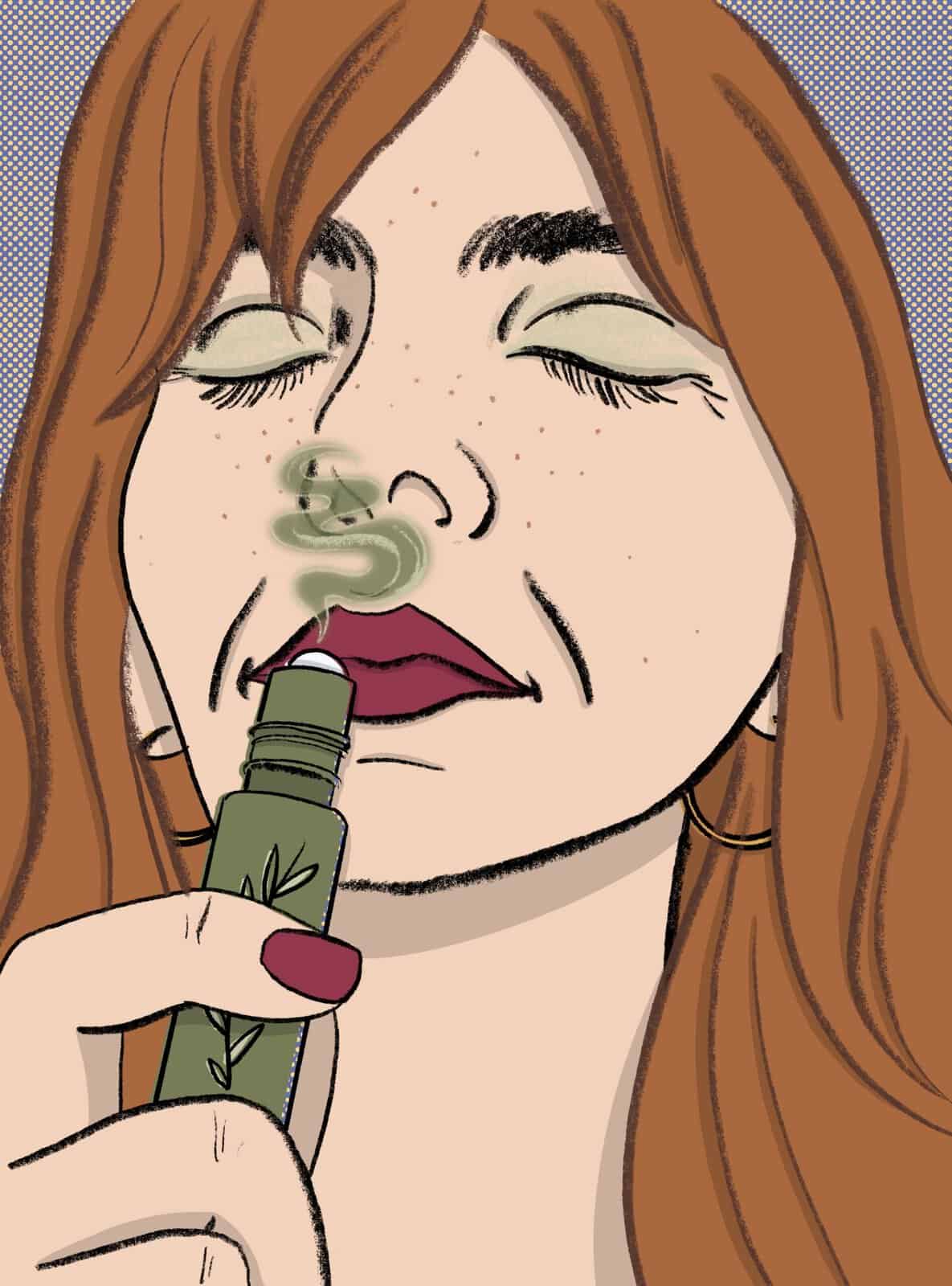
Johnson started to try and get her sense of smell back on her own. Friends helped compile research on smell training, while colleagues connected her with others who had regained some ability after anosmia. Now, three times a day she smells a pungent essential oil. She began with juniper, lemon, clove, and eucalyptus, rotating to a new set of oils after a few months. Her doctor also recommended supplements that could support recovery: vitamin A for neuroplasticity and nerve regrowth, vitamin B complex for overall recovery and reduction of mucus, and vitamin D, saffron, and magnesium for mental health. “I would encourage anybody going through this to seek support before it gets to the point where you’re talking to your doctor about depression,” Johnson says. “You probably know somebody who’s gone through something similar, and they might have a roadmap that can help you get back to where you want to be.”
After roughly three months of her essential oil regimen—nearly a year after her initial illness—Johnson thinks she’s three-quarters of the way back to normal. Her sense of smell is improving, she can identify the five basic tastes, and she’s begun enjoying cheese again: her favorite, Chällerhocker, was the first she recognized since her sensory loss. She’s also decided to take the CCSE Exam this July. If she passes, she’ll be one step closer to getting back on the judging circuit. “I feel like having any of your senses is such a privilege,” Johnson says. “It’s probably one of the most basic things we take for granted.”
Alexandra Jones
Alexandra Jones is a writer and recovering cheesemonger based in Philadelphia. Her work on food, agriculture, social justice, and sustainability has appeared in outlets like USA Today, Food & Wine, Atlas Obscura, Civil Eats, The Counter, Audubon, the Philadelphia Inquirer, and Modern Farmer. She’s the author of Stuff Every Cheese Lover Should Know, a pocket guide to cheese from Quirk Books.