
How cheese provided the perfect cover for a World War II-era spy
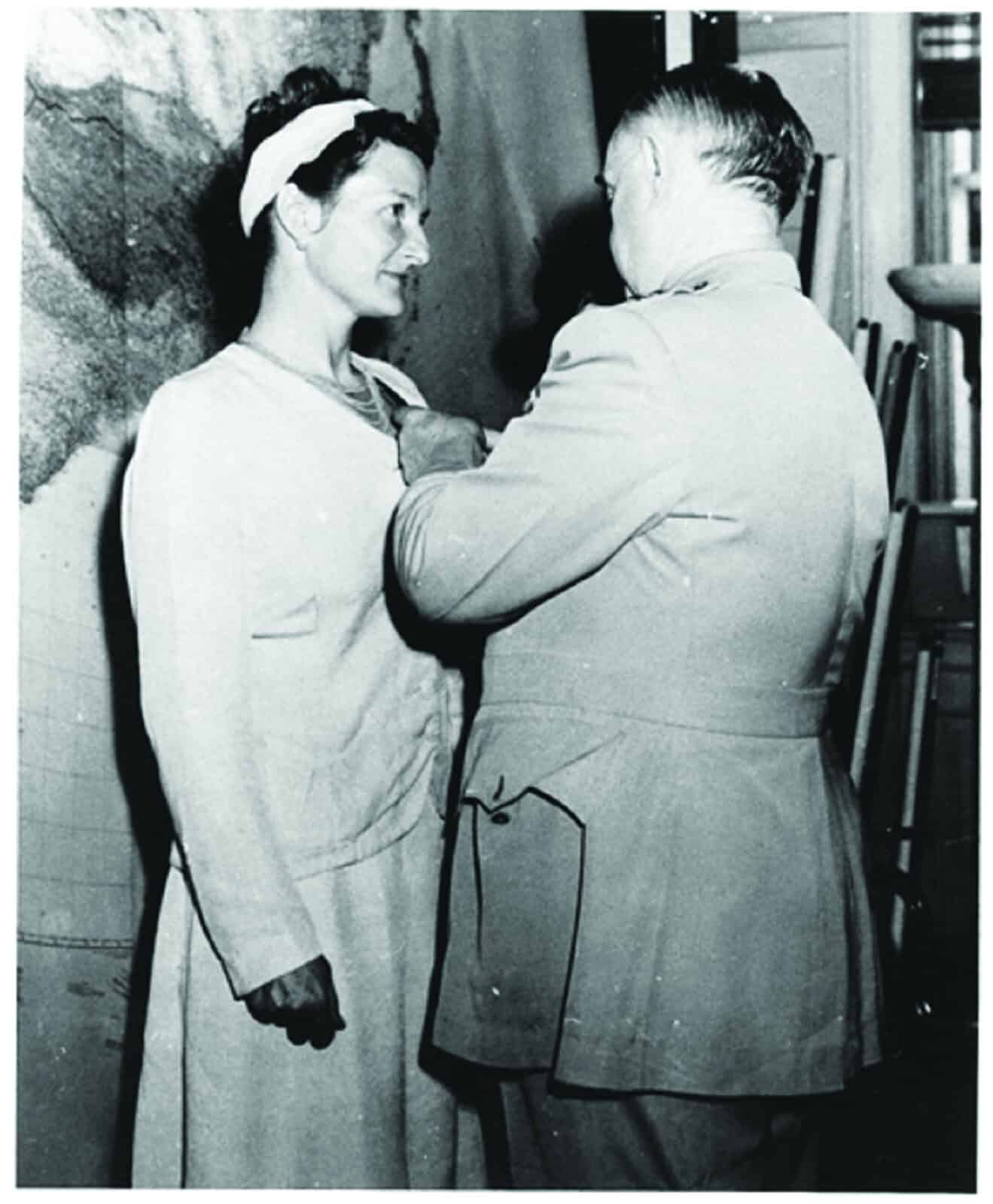
Virginia Hall with General William Donovan in 1945. Photo courtesy of Wikimedia Commons.
It’s difficult to envision James Bond shaping rounds of goat cheese as part of his latest operation. However, that is exactly what Virginia Hall did. While in deep cover during World War II, the “most dangerous of all Allied spies,” according to the Gestapo, went so far as to offer cheese samples to her jackbooted quarry.
Transformation was Hall’s ace up her sleeve, whether she was turning milk into cheese or morphing from the heiress of a wealthy banker into a callus-handed French dairymaid. What was most remarkable was how someone with a prosthetic limb could so persistently elude notice.
Being a spy wasn’t Hall’s first career choice. After graduating from Columbia University, she arrived in present-day Izmir, Turkey, as a lowly clerk in diplomatic service. While hunting snipe in the countryside, Hall’s shotgun accidentally fired. The self-inflicted injury resulted in the amputation of her left leg below the knee. The 27-year-old, now encumbered with a prosthetic leg she wryly named “Cuthbert,” returned to her role as a clerk; however, her disability now disqualified her from ever becoming a diplomat.
After the war broke out, Hall found her way to England, where her career path took a sharp turn. Volunteering for the Special Operations Executive, she spied for the British in Nazi-occupied France, masquerading as a New York Post reporter.
Her dangerous and eclectic duties included developing a 90-agent resistance network in Lyon, guiding downed airmen to safe houses, and coordinating supply drops. Because of her key role in resistance operations, Hall was soon on the Gestapo’s radar. By late autumn of 1942, it was time for her to flee. Escape from enemy territory involved a 44-mile trek through the wintry Pyrenees mountains. It would have been a challenging expedition, even for someone without a 7-pound prosthetic leg.
In 1943, King George VI honored Hall’s service with an MBE award, or Member of the Most Excellent Order of the British Empire. Keen to continue her work, Hall received this accolade in secret. Eighteen months later, she returned to France, now working for the Americans. Her disguise involved filed-down teeth, darkened hair, and padded clothing to pass as an old French peasant named Marcelle Montagne.

The French identification certificate for Virginia Hall’s cheesemaking alias: Marcelle Montagne. Photo courtesy of Wikimedia Commons.
At this stage of the war, agents like Hall were preparing ahead of D-Day. On-the-ground intelligence remained vital to success. Operating mostly alone in enemy territory, Hall was stationed with a sympathetic farmer in the village of Maidou-sur-Crozant. This is when she got the idea to help the farmer’s mother make cheese to sell to the Nazis, which would provide cover while she mingled with occupying forces.
The risk was stratospheric—her image had been widely circulated by the Nazis. But Hall was used to high stakes. She transformed her telltale limp into an old woman’s shuffle as she approached a German convoy with farmhouse cheese. Tasting ensued, and her rasping voice and labored gait were genuinely accepted by the appreciative soldiers.
However, a few days later, German soldiers unexpectedly arrived at the farm. Hall had just completed a radio report, and when she emerged from the cottage, the Germans confronted her. They stormed the cottage and began to turn it over for anything incriminating. Hall stuck to her cover. Remarkably, the soldiers emerged empty-handed.
A German officer recognized her as the cheese seller and the mood lightened. He complimented her on the cheese, took some more, and left some money, never knowing how close he’d been to capturing her—she who the Reich famously dubbed the “Limping Lady.”
Hall survived the war. She was awarded the Distinguished Service Cross—the only civilian woman to receive this distinction in World War II—and went on to serve in the CIA. Whether she continued to sieve curds is a detail lost to history.

Chris Allsop
Chris Allsop is a UK-based food and travel writer whose work has appeared in The Guardian, The Sunday Times Travel Magazine, and Yahoo!, among other titles. He lives in Bath, where he eats way too much cheddar.