
White Jasmine’s founder talks about her journey to making cheese connected to her home country of Pakistan.
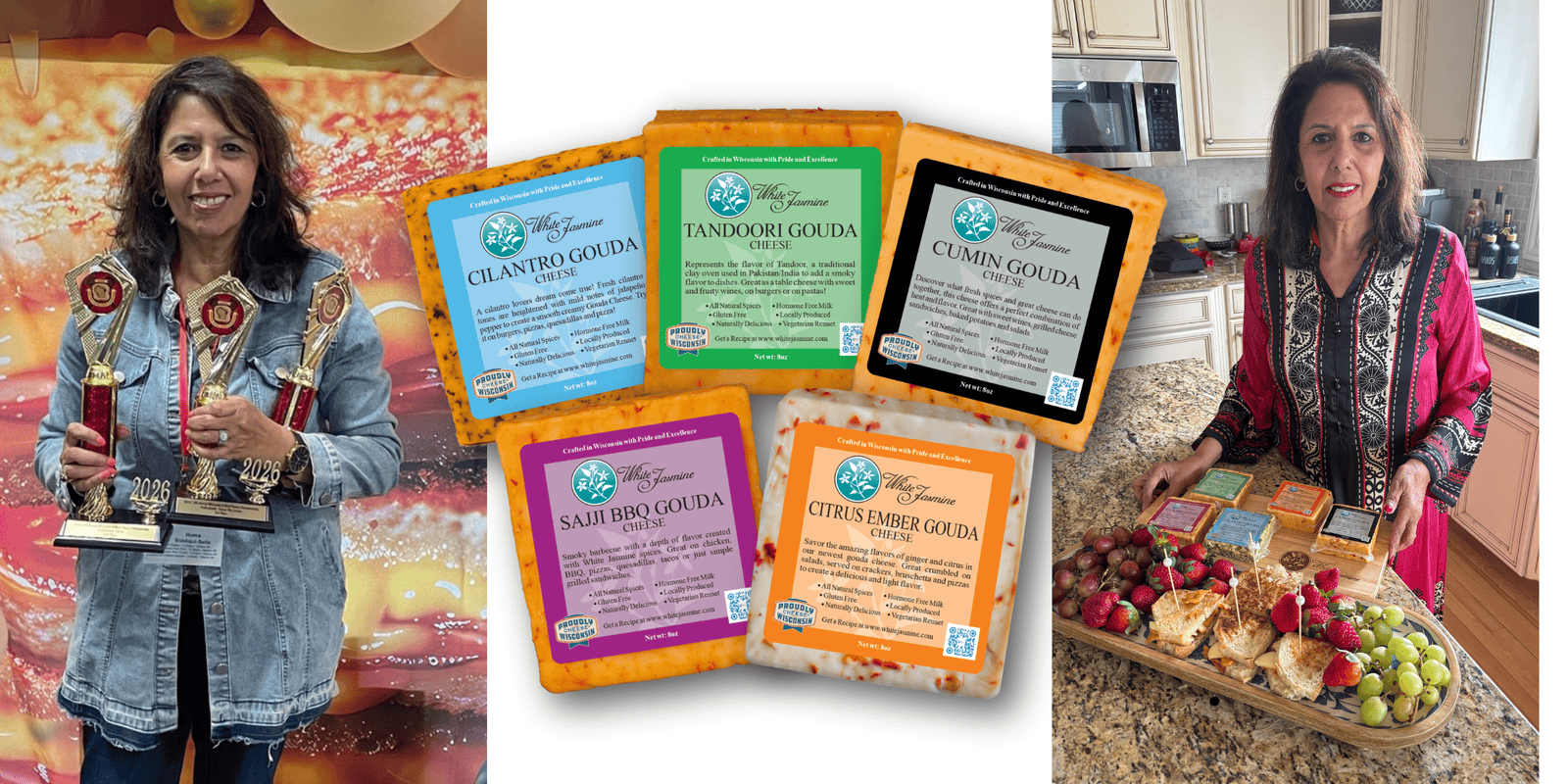
South Asian cheese is more than paneer, and Huma Siddiqui is proving it with her cheese company, White Jasmine. Based in Wisconsin, White Jasmine produces a line of goudas with mouthwatering names such as Citrus Ember, Saji BBQ, and Tandoori. All of White Jasmine’s cheeses are infused with Siddiqui’s proprietary imported spice blends, which are available for purchase on White Jasmine’s website.
As a passionate culinary educator, she says one of her goals is to help people cook flavorful food at home. “You don’t have to eat bird food,” says Siddiqui. “I encourage people to add layers of flavor and less salt.” Her methods have won her awards, including multiple trophies at the 2026 Wisconsin Grilled Cheese Championship; Siddiqui’s grilled cheese featuring sourdough bread, Tandoori, apple-cinnamon jelly, and a side of apple slices is a perfect example of her approach in practice.
Read on to learn how Siddiqui came into her own as a cheesemaker in Dairyland—and why she’ll never tone down her spicy goudas.
Culture Media (CM): Tell me about your journey to Wisconsin, and all the places you stopped along the way.
Huma Siddiqui (HS): I grew up in Pakistan and then left the country, got married, and went to North Africa. I lived there for about five years and then lived in England for about 11 years before moving to Mount Horeb, Wisconsin.
Growing up in Pakistan, we only had paneer. My dad used to travel quite a bit and time to time, he would bring some cheese home, like a cheddar. That was my western experience. I had never seen so much cheese in my life [before I came to Wisconsin].
We didn’t know what to expect from Wisconsin. We didn’t know the state. I started to realize that this is very much a farm and dairy land. That was interesting because when you are away in a different country, your perspective about another country is very different. We came here as tourists and went to Florida and New York. It was interesting to figure out that Mount Horeb was a small town and feel like I was home. That’s a good feeling—it’s human nature to want to belong somewhere and Wisconsin does that for us.
CM: What about your background as a culinary educator?
HS: I never went to school for food. I didn’t really cook much at home because we had a lot of help. But after moving to the US, I started to cook and invite people over—I like connecting with people, and food is a big connector no matter which country I’ve lived in. I also wanted to give my kids authentic dishes that I grew up with.
My background is actually in accounting, so food is very much a passion. Teaching my classes and creating new flavors, that all comes from a different place. Accounting is very to the point and cooking is very much creating something new. I just know my flavors and I love them.
View this post on Instagram
CM: Why did you decide to infuse White Jasmine cheeses with Pakistani spices?
HS: No offense, but the food in Wisconsin is very bland. I thought, “I want to introduce these flavors and see if anybody likes them.” And I wanted to teach culinary classes as a hobby.
That kind of grew as I realized that people love spices. They love flavors, but they don’t know how to use them. So, I created my spice blends, like Tandoori Masala with 13 different spices in it—you can just take a couple of teaspoons and throw that in your food without searching for all these different spices.
When I buy cheese, I bring it home and I add things to it to make it flavorful. I thought, “Maybe there are other people who would like this, too.” Wisconsin being Dairyland, I thought, “I’m going to try and make some cheese with my spices in them.” That’s how I went to work with University of Wisconsin–Madison to create the recipes for White Jasmine cheeses.
CM: What was it like learning how to make gouda?
HS: [At University of Wisconsin–Madison,] we tried different cheeses, but gouda seemed to be holding the spices’ flavors really well. We honed in once we realized that. I wanted to create a cheese that I could cook with—you know, make a grilled cheese sandwich, put it on pizzas, quesadillas or tacos, baked potatoes, wherever I can add a little bit more flavor.
View this post on Instagram
CM: Did you face any challenges during the development process?
HS: When we did create those recipes, the cheeses were quite spicy and flavorful, which was very different than what we found in stores. My cheesemakers would say, “Maybe you should tone it down.” But that’s what I wanted. If it didn’t sell, or if nobody liked it, I decided my friends would get this cheese for the rest of their lives.
You never know what the market is going to do. We really thought that our tandoori gouda with so many spices in it would be the last one to sell because this is the Midwest. Surprisingly, that is our bestseller. My customers tell me they use it in scrambled eggs.
So, one of our challenges was creating something different, but also hanging my hat on the belief that this was my recipe and I was not going to change it. Sometimes, you have to be very stubborn about your idea.

Alana Pedalino
Alana Pedalino serves as Managing Editor of culture. Her work has been featured in Bon Appétit, Chicken Soup for the Soul, and more. She loves to write, cook, and kayak. Find her bylines at alanapedalino.com.