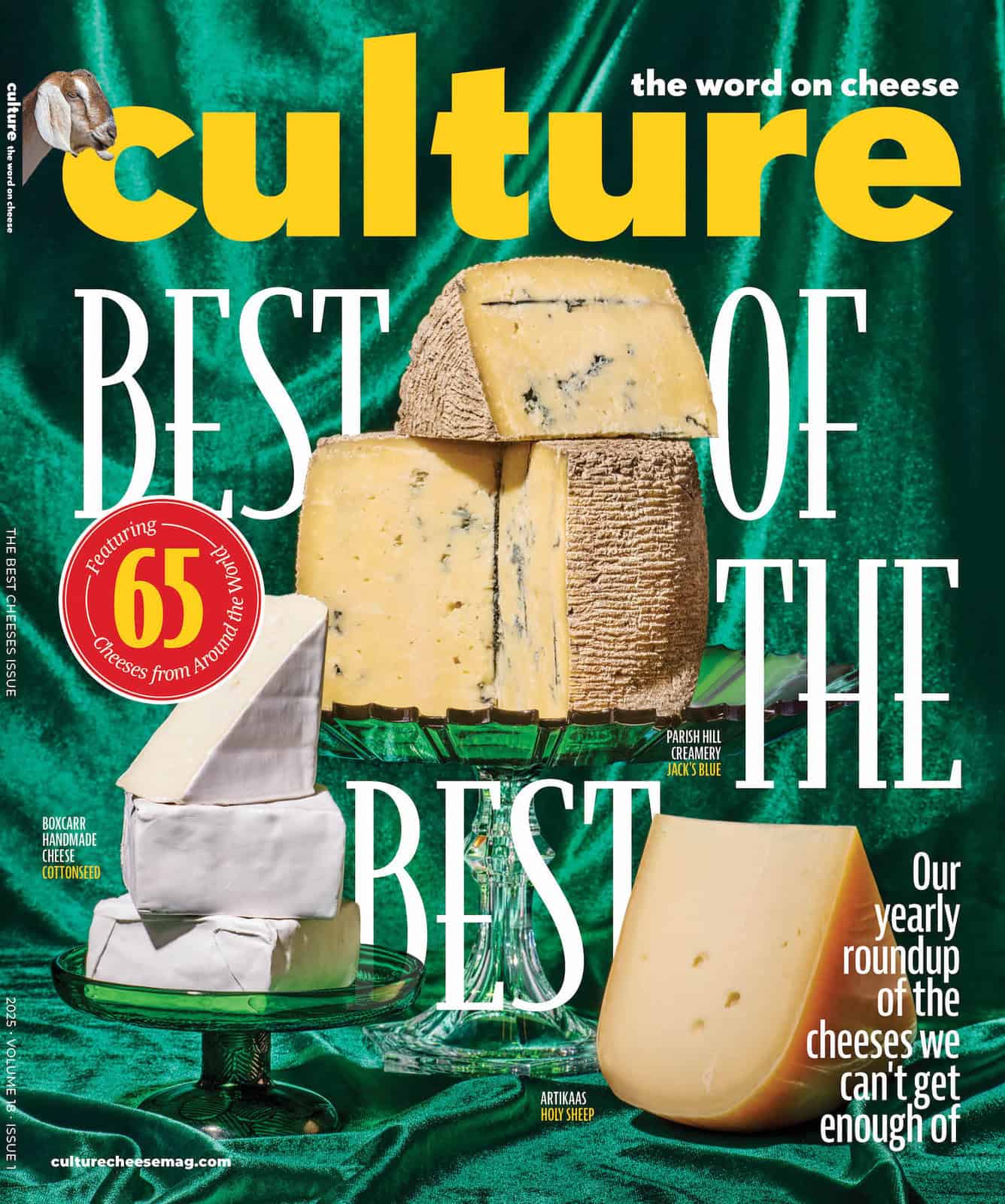

How Jasper Hill Farm sets the bar for blue cheese
For nearly two decades, Bayley Hazen Blue has defined Jasper Hill Farm’s approach to blue cheese. Since its debut in 2003, the flagship blue-veined beauty has collected myriad accolades, including a spot in the top 14 at the 2024–2025 World Cheese Awards. In 2024, the creamery introduced two new variations: Withersbrook Blue, a square format aged in a cryovac pouch with a splash of local Eden Ciders Ice Cider; and Barnstorm Blue, a collaboration with the Murray’s Cheese Caves team, washed in malty ale from Focal Point Beer Co. Though the trio shares the same recipe, each develops its own personality.
The results speak for themselves: At the 2025 American Cheese Society Judging & Competition, all three of Jasper Hill’s blues landed in the top 10, with Withersbrook taking home Second Place Best of Show. There is no denying that Jasper Hill is setting the standard for American blue cheese—and perhaps blue cheese everywhere.
Co-founder Mateo Kehler attributes Jasper Hill’s success to the foundation of its cheeses: high-quality raw milk from its herd and the microclimate of Vermont caves. “We are cheesemakers who are farming, not farmers who are making cheese,” he says. “Ultimately, as cheesemakers, we’re looking for ways to really celebrate and highlight the milk and the farming system that connects the cheese to the landscape and all the practices that inform the microbial ecology of our cheeses.”
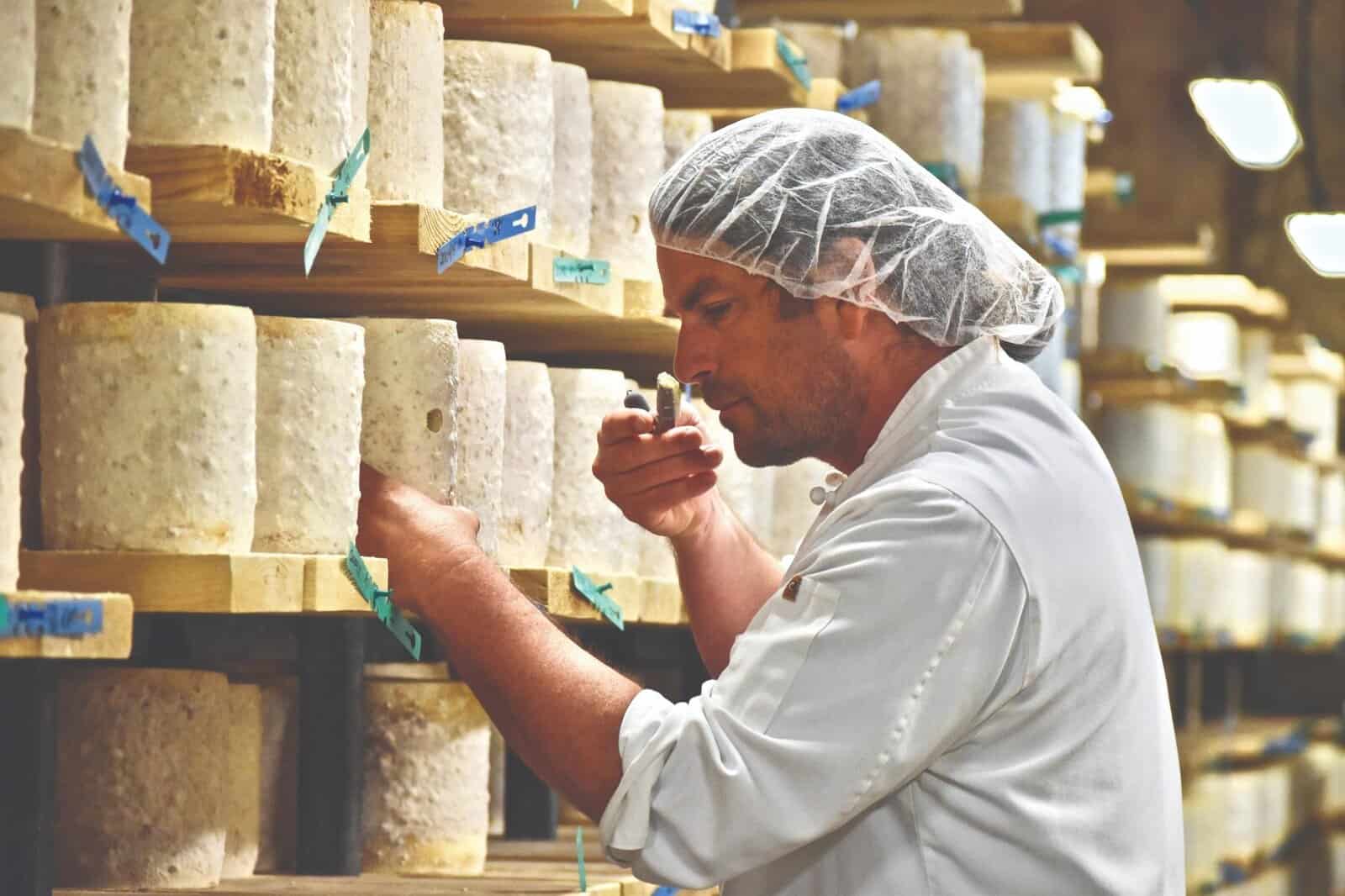
The second pillar of success is the Cellars—the on-site aging facility where Jasper Hill has shaped its style over time. Blues are aged at a warmer temperature than usual producers—around 57 to 58°F—which encourages proteolysis (protein breakdown) over lipolysis (fat breakdown). The result? Sweet, umami depth without the methyl ethyl ketone flavors that can be unappealing. Kehler believes initial ripening at a warm temperature is the key to making approachable, standout blues.
From that foundation, Jasper Hill has reimagined how its family of blues takes shape—not by changing recipes, but by exploring form and affinage. “When you change the shape of a cheese, it changes salt migration, drainage, the rind-to-paste ratio, moisture and acidification dynamics,” Kehler explains. “It becomes a totally different product.”
This artful balance of precise milk sourcing, intentional cave-aging, and exploration of new formats has allowed Jasper Hill to redefine what American blue cheese can be. By pushing boundaries while staying true to its raw-milk roots, Jasper Hill’s not just perfecting a style—it’s revolutionizing it.

Josie Krogh
Josie Krogh is culture's Digital Strategy Lead. She earned her master's degree in Agricultural and Applied Economics from The University of Georgia. Josie developed a love of food while working at farmstands in the D.C. area as a young adult, and discovered her love of cheese while living and working on a dairy farm on Martha's Vineyard. Josie currently lives in Catskill, NY.