
How a call to “Save British Cheese” turned into a thriving London market dedicated to cheese
Imagine planning a visit to London and learning that there is a monthly outdoor market entirely dedicated to cheese. On a scale from immediately to yesterday, how quickly would you prioritize the pilgrimage?
Taking place monthly on every third Sunday in a London borough named for its cheese, the Chiswick Cheese Market doesn’t just have its finger on the pulse of the British cheese industry—it is the pulse of the British cheese industry.
“I was born loving cheese,” says Lucy Cufflin, one of Chiswick Cheese Market’s founders and a chef and caterer by profession. “I have no idea why … I think some people just are.”
The Chiswick Cheese Market is a labor of love for Cufflin and the volunteers who operate it. Officially founded in 2021, the market is quickly approaching its fifth anniversary and shows no signs of slowing.
We recently caught up with Cufflin to talk about the importance of providing a forum for the artisan cheese industry, educating consumers about good-quality cheese, and supporting the next generation of cheesemakers.
culture (CM): What was the motivation behind starting the Chiswick Cheese Market?
Lucy Cufflin (LC): I’d written a couple of cookbooks, and I was doing an event at the Chiswick Book Festival and met a lady called Jo Pratt, who is also a local cookbook author. We first put a team of women together called Cookbook Kitchen, with the idea of coordinating an annual cookbook festival. That was all kiboshed during COVID, but at the same time, chef Jamie Oliver put out a call to “Save British Cheese” because the artisan cheese industry was struggling.
All the animals were still producing milk, of course, but widespread restaurant closures meant that cheesemakers had lost their route to market.
Chiswick, which used to be called “Cheesewick” (meaning “cheese farm” in Old English), was converting a parking area on its main street into a licensed market so people could trade outside during the pandemic.
We decided we would answer the call to help cheese producers, but also bring British artisan cheese to the fore and bring it home to Chiswick. We phoned people and traipsed wherever we could to find cheese producers and people who would come. We started with 18 stalls in May 2021, and we had queues at the gates to get in.
CM: How has the market grown since then?
LC: We’ve gone from 18 to 59 stalls. Some of the traders we have today were our first traders. They stuck with us and flourished with us.
Now we have accouterments as well as cheese. We’re very keen that it’s a great, fun event and there’s lots to do, but we want to keep it a retail market as much as possible so people will come and buy. Because that’s what sustains the traders.
We have a fine balance between being an event that’s worth traveling to, and also just keeping it retail with people wanting to purchase cheese.
CM: What does a typical day at the market look like?
LC: We start at about 6:45 a.m. and allow the first traders to set up at 7 a.m. By law, we have quite a lot of paperwork we have to check because we’re a food market.
We set up our HQ stall (which includes Buttercup, the resident cow mascot), where we try to have something educational every month—something with a producer, or a comparative tasting with a simple message.
Once we had Mary Quicke bring the same cheese in three stages of aging because people didn’t necessarily understand what affinage is. Education was always a big part of our idea.
When we get a new trader at the market now, they’re always blown away by our regulars and the questions they ask. They don’t want to just buy a nice piece of artisan cheese; they want to know exactly where it’s from and how it’s matured.
Then I circulate and taste. I’ve been compiling bits of film, one cheese a month, where I’ve really talked in depth to whoever’s selling it. My real passion is cooking, so it’s about how to really enjoy and make the most of artisan cheese.
We also write a newsletter once a month, and I always impart a little bit of knowledge I’ve learned that you wouldn’t necessarily know unless you spoke to a cheesemaker or a monger.
Part of the day might also be problem solving or dealing with logistical issues. A lot of time is spent working with the traders to make sure they’re happy because without traders, we have no market.
We also interact with the local businesses and the visitors. We have a lot of regulars, and we see them every month and chat with them, and then before you’ve blinked, it’s half past 2 p.m.

CM: What new vendors are you looking to add to the market, now that you’re well-established and have a reputation to uphold?
LC: For non-cheese vendors, they have to have something to do with cheese in order to justify our license as a cheese market with the local council. So, we have to find a loose connection.
We allow non-cheese vendors to have a contract where they come to only four markets throughout the year, so the options always feel varied.
For the cheese vendors, we do try and curate. We have a very open door for all producers. A new monger would have to bring us something that our customers would find really interesting and that we don’t necessarily have, or are very curated collections.
For example, we’ve got someone who wants to bring cheeses from the Yorkshire Dales in Northern England, and that’s really interesting for us because they’re quite small producers, and we don’t see them at some of the bigger mongers in London.
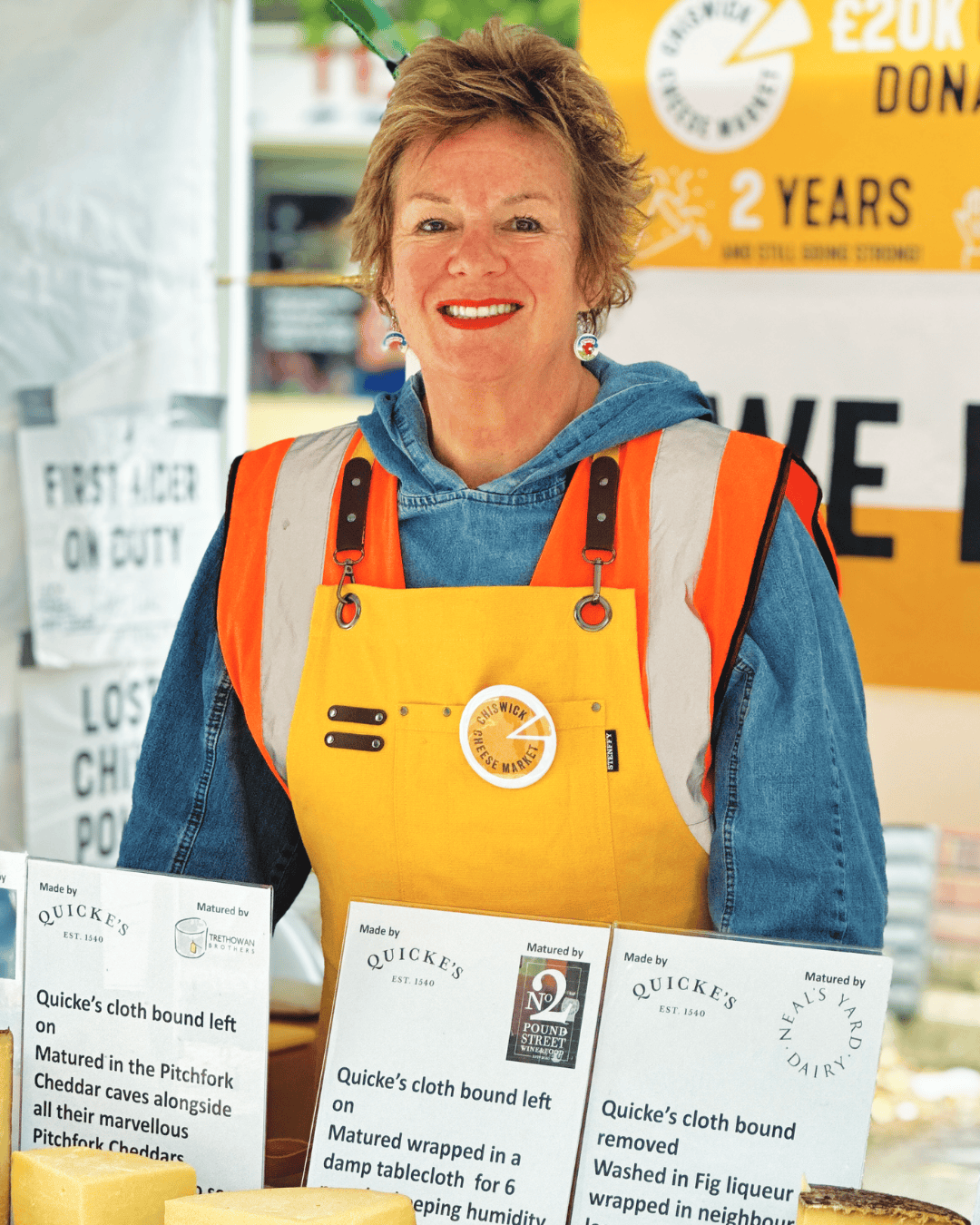
Another example is No2 Pound Street, a monger in Wendover. They only ever bring four cheeses to the market, and that’s because they pick the ones that are seasonally good and that they think are at their best, and then they really have the opportunity to talk to people about them.
So we would be interested in any monger who had that sort of ethos. We are very conscious about the provenance and the quality, and we don’t let people come back if the quality isn’t excellent because we don’t want to be seen as authorizing the sale of something that’s not great.
We believe we have built a reputation where you could come to the Chiswick Cheese Market and buy some of the best cheese in the world.
CM: Can you tell us about how the Chiswick Cheese Market is also nurturing and supporting new cheesemaker talent?
LC: We’re all volunteers who run the market and the traders pay for stalls. Over four years, we’ve given over $46,000 away in charitable donations or sponsorships.
We do give quite a lot to a local shelter, but we also sponsor several new cheesemakers a year in liaison with the Academy of Cheese. We put up the money, and then we work with the Academy to recognize what individual cheesemakers need in the way of education or help.
Last year, we sponsored five new cheesemakers, and they will all be selling their cheeses at the market in September. This year, we’re sponsoring two so we can give them more each in terms of education and consultancy or technical help.
We’re also sponsoring a trophy at the World Cheese Awards, the washed-rind category at the Artisan Cheese Awards, the hard cheese category at [Academy of Cheese’s] Affineur of the Year, and the Real Cheese Project’s People’s Cheese award. It will be the customers at Chiswick Cheese Market who decide who goes through to the final.
This is all about furthering artisan British cheese. I think we have really expanded the knowledge of artisan cheese to our customer base, but I think we’ve also managed through the market to support parts of the artisan cheese industry in small ways that have enabled it to keep going.
CM: Since starting the market, how do you think the British cheese industry has changed or developed?
LC: Four years is a short time, and it was already happening hugely anyway, but a lot of our British cheeses—apart from our heritage cheeses like Double Gloucester, Wensleydale, and Cheddar—were copies of established European cheeses, which is absolutely fine.
I think what we’ve done, though, is take some cheeses that are classic European recipes and we have made them our own. Now we’re making versions that are different and extraordinary, and I think the recognition of affinage in the UK over the last five years is what’s changing the industry.
We are very liberated to be able to experiment because our history of cheesemaking is not set in stone. We have some really experimental and great chefs, and it’s the same with the cheesemaking industry. I think sometimes our lack of food history can be an advantage.
CM: How do you hope the Chiswick Cheese Market evolves in the coming years?
LC: I think it’s about maintaining our quality. It’s not about expansion. We’re not aiming to make the market bigger. Our aim is to refine it and continue growing in quality and provenance, and getting our name out there so that more people will come learn about and buy good cheese.
A continual aim is to have more visitors, and to perhaps expand our reach so we can do more with our grantees.
We have no dreams of franchising it or being some sort of entity that’s bigger because we feel it depends very much on human conversations and contacts, knowing our traders and our customers, and knowing their farms and animals.
One of our aims is to really be known within the trade and by the public that, if you want to try new cheese, this is the place to come.
CM: Has running the Chiswick Cheese Market changed your relationship with cheese in any way?
LC: The biggest change is that I would have always kept some supermarket cheese in the fridge for cooking, and now I don’t. Because why wouldn’t I want the best?
If I’m going to add cheese to a dish, I’m adding it because it’s going to bring something to the party, not just because it’s making a crunchy topping or something.
If I’m making a venison burger, I’m really choosy about the meat, and if I turn that into a venison cheeseburger, I’m really choosy about the cheese I put on it.
So why would I want a slab of something for the sake of melting? I think what I’ve learned over time with cheese is to eat less but better, and I do that with lots of things now.

Alana Pedalino
Alana Pedalino serves as Managing Editor of culture. Her work has been featured in Bon Appétit, Chicken Soup for the Soul, and more. She loves to write, cook, and kayak. Find her bylines at alanapedalino.com.