
Pamela Vachon ruminates on a different kind of cheese plate.
Growing up, cheese in my family’s Midwestern household usually came in plastic-wrapped blocks, cubes, or slices. The dairy appreciation was strong, but anything bordering on artisanal just didn’t cross my path until adulthood. Even conventional brie or gouda wasn’t anywhere on my radar. I was well into my 30s when I tasted my personal conversion cheese. You know the kind—the selection that shifts your consciousness toward cheese as something that has a life outside the supermarket.
Considering the fact that I became a cheese writer and educator (such is the power of a conversion cheese), when my mother asked me whether I wanted to keep my recently departed grandmother’s cheese plates, it was a record-scratch moment. Cheese plates? What’s that now? That my grandmother may have been harboring items dedicated to cheese service was as odd a notion as if my mom had asked whether I wanted her paintball set or sous vide equipment. All were equally hard to imagine in the hands of my diminutive, old-fashioned grandmother. How could I have not known items such as cheese plates existed in her realm, tucked away among the Pyrex casserole dishes? We weren’t a cheese-in-that-way kind of family.
Naturally, I said yes to acquiring them, not even knowing what exactly they were.
If I am honest, I’d had a hint about my grandmother’s cheese appreciation in the last couple years of her life, which I wish I had explored further while I still could. As a fine dining server and budding journalist, cheese had become my beat, and I wanted everyone to have their conversion moment, even those whose enthusiasm toward fancy cheese topped out at hesitant. At a family Christmas, I assembled a cheese plate for beginners, populated only with the friendliest, crowd-pleasing artisanal selections: nothing runny, sticky, or pungent. Mostly for myself, I’d included one small bit of Rogue River Blue, which had recently been crowned Best Cheese at the World Cheese Awards and was miraculously available in suburban Michigan—thanks to Murray’s Cheese’s recent presence in Kroger stores.
I was already surprised when anyone other than myself tasted the blue cheese, and even more so when my grandmother declared it the best cheese she’d ever eaten. (Take that, World Food Awards.) How could I not know that my grandmother may have been a blue cheese aficionado?
The following year, which would turn out to be her last Christmas, I gifted her a generous portion of Rogue River Blue, as well as some fig preserves to accompany it. Several months later, after her death, my mother had been cleaning out her refrigerator and mentioned to me the fig jam jar was mostly empty, and the cheese, rightfully gone.
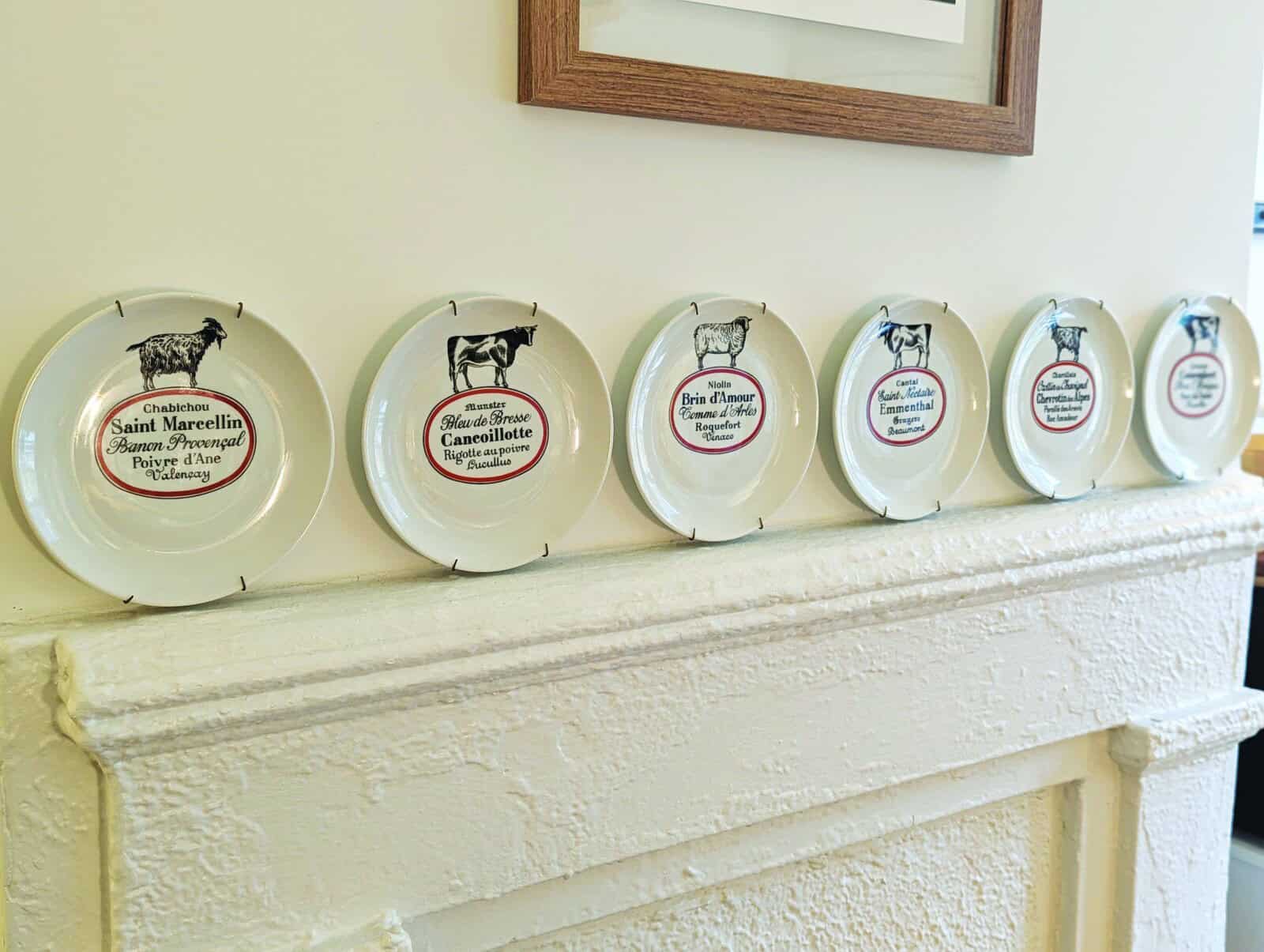
When her mysterious cheese plates came into my possession, of course I recognized them instantly. They’d always hung on a wall in my grandparents’ kitchen, a gift that my grandfather had given her as an anniversary present, I learned.
The six porcelain plates each display the image of a cow, ewe, or goat, and a corresponding list of French cheeses: Cancoillotte, Roquefort, Valençay, etc.—names that had all become familiar to me in recent years. I’d just never really noticed the plates because I’d first observed them with a child’s eyes, unable to interpret their message. Though I had taken them in numerous times since, they’d become invisible, as things sometimes do when we see them all the time. Not knowing that my grandmother was someone who appreciated cheese to the extent that she evidently did, the meaning of the cheese plates had been lost on me most of my life. But at the end of my grandmother’s, I came to understand.

Pamela Vachon
Pamela Vachon is a freelance food and beverage writer and educator based in Astoria, New York, whose work has appeared in Bon Appétit, Wine Enthusiast, and VinePair, among others. Formerly a bartender and captain at New York’s two Michelin star restaurant, The Modern (where her cheese education began as a driver of a tableside cheese trolley), she is also a certified sommelier, and leads cheese, wine, and cocktail tastings through Murray’s Cheese and Night Inn.